
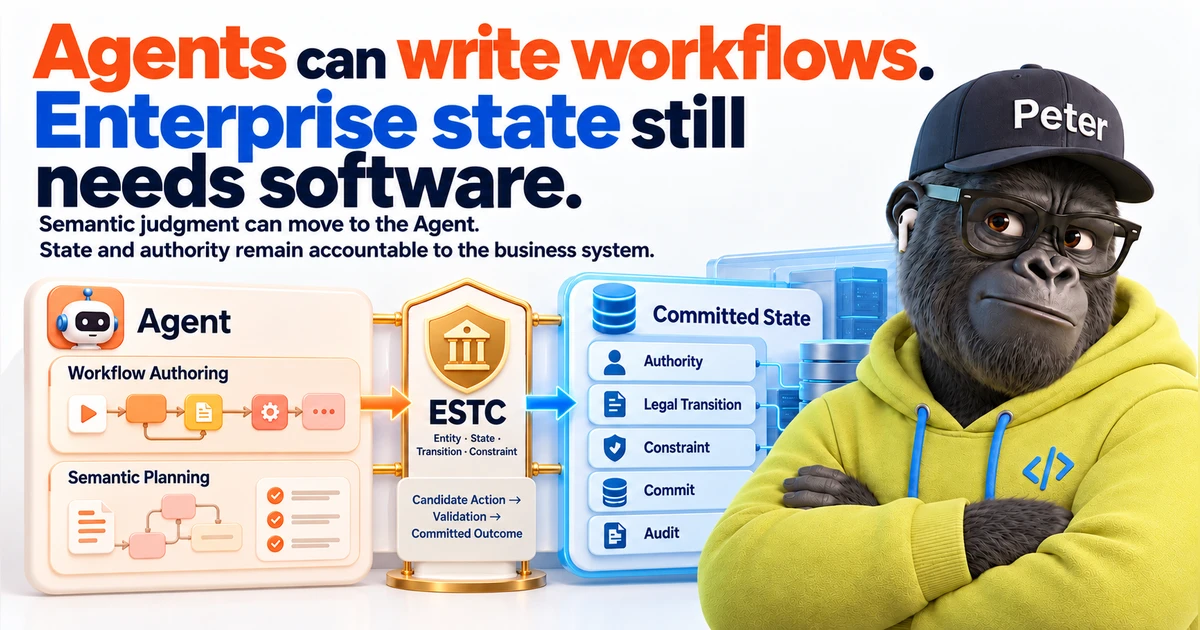
A claim shows up increasingly often in discussions about AI agents: if Claude Code, Codex, and similar agents can write code, discover APIs, call tools, inspect failures, and repair their own work, why would we still need workflow tools such as n8n?
At first glance, the argument is reasonable. I also expect agents to absorb a large part of the manual work involved in drawing nodes, wiring conditions, and configuring integrations. n8n itself moved in that direction in 2026: its Assistant can build, run, and repair workflows from natural language, while its Agents product lets an agent use existing workflows as tools.
But there is a larger assumption hiding inside the argument.
n8n is ultimately software. Its canvas happens to make Trigger, Condition, Branch, Credential, API Call, Retry, Error Handling, and Approval visible. Make and Zapier are not fundamentally different in that respect. The same logic could be written in TypeScript, Python, Java/Spring, Step Functions, or Temporal.
So if we push the claim to its logical end, the real question becomes:
If an agent can author a workflow, does that mean the execution rules embodied by the workflow are no longer necessary?
I do not think so. In enterprise systems, the distinction becomes even more important.
Authoring a Workflow Is Not the Same as Eliminating Workflow Semantics
It is worth conceding the part of the argument that is likely correct.
The cost of workflow authoring will fall sharply. A human used to read a requirement, select a trigger, choose API nodes, create branches, and design failure paths. Increasingly, an agent can take a request such as “when a new lead arrives, find the owner, update CRM, and notify Slack” and construct much of that flow.
Anthropic makes a useful architectural distinction in Building Effective Agents: workflows follow predefined code paths, while agents dynamically direct their own processes and tool usage. The same guidance notes that predictable, well-defined tasks still benefit from workflow-style consistency.
The crucial point is that three concerns should not be collapsed into one:
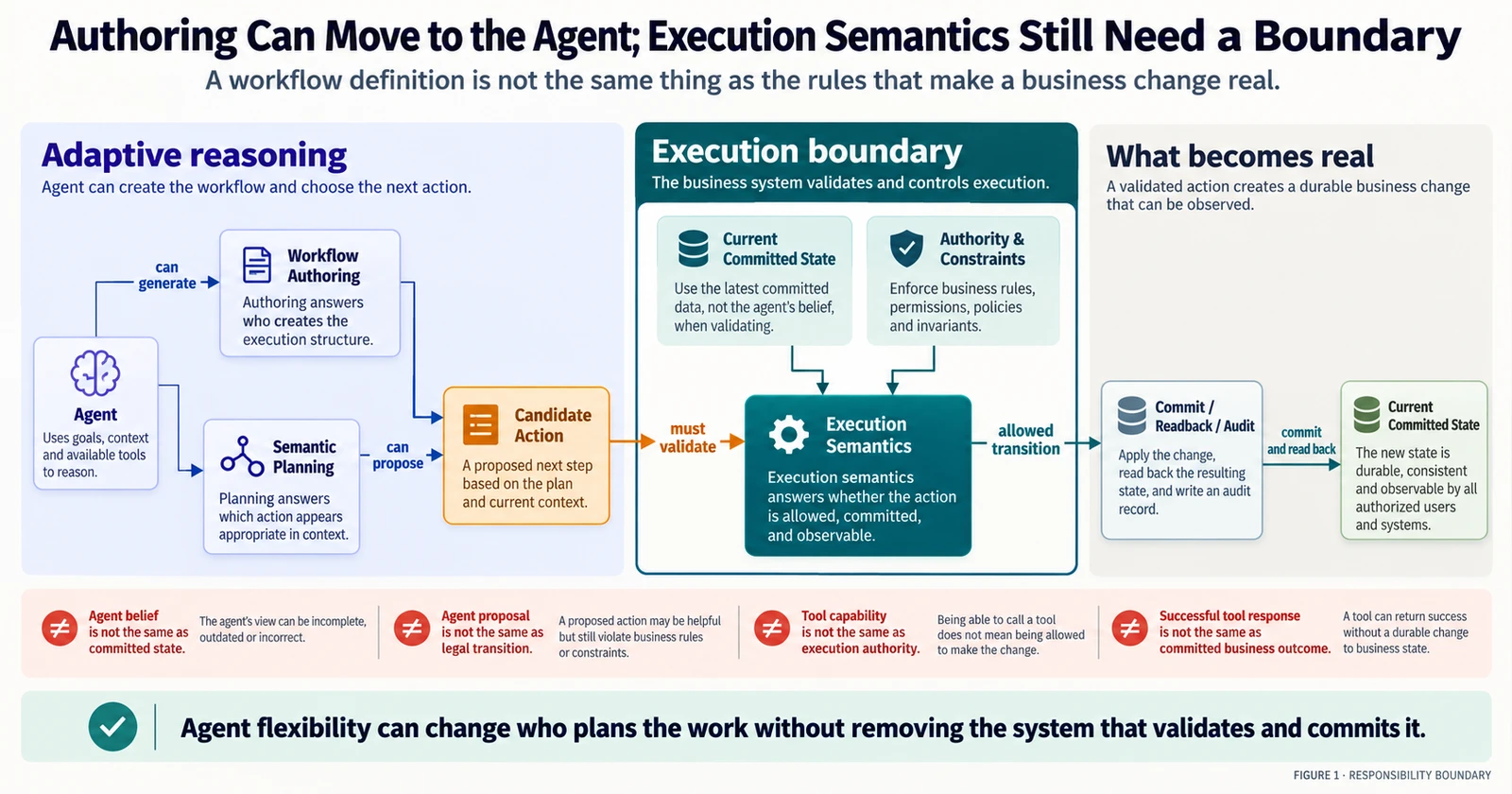
- Workflow Authoring — who creates the execution structure
- Semantic Planning — who interprets context and chooses candidate actions
- Execution Semantics — what rules are allowed to change real business state
Agents are quickly absorbing the first two.
The third is a different problem.
Enterprise Work Is Closer to Shared State Than a Task List
Enterprise work rarely consists of a private sequence of tasks inside one person’s head.
Consider a Salesforce Opportunity. It moves from Prospecting to Qualification, Proposal, Negotiation, and eventually Closed Won or Closed Lost. The important fact is not that a Stage field exists. It is that Sales, SE, Finance, Legal, and management all use that state as shared business reality.
“This deal is now in Negotiation.”
Multiple actors have to understand that statement in the same way before they can coordinate the next action.
Contracts have Draft, Review, Approved, and Signed states. Support cases move through New, Assigned, Waiting, Resolved, and Closed. Orders, invoices, claims, change requests, and deployments have their own versions of the same pattern.
And transitions between those states have conditions.
A discount approval is not simply an ApproveDiscount tool call. The system may need to know the current Opportunity state, the caller’s role, the discount percentage, the amount requiring higher approval, whether Legal or Finance prerequisites have been met, and whether another transition is already in progress.
Only then should the business object actually change.
An enterprise is certainly a collection of people dividing work. From a systems perspective, however, it is also a collection of actors coordinating around shared state and permitted transitions.
That is the part that disappears too easily in “the agent will do everything” narratives.
ESTC Makes the Remaining Responsibility Easier to See
For this article, I use a simple lens: Entity–State–Transition–Constraint, or ESTC. I am not presenting ESTC as an established academic standard. It is a compact way to reason about what must remain explicit when an agent starts changing real systems.
Entity is the business object being changed: an Opportunity, Order, Contract, Case, or Invoice.
State is not what the agent believes to be true. It is the state the organization currently treats as committed fact.
Transition is a state-changing action: Approve, Refund, Assign, Close, Publish, Deploy.
Constraint defines when the transition is legal: identity, role, permission, approval, amount, compliance rule, current state, or separation of duties.
Once the problem is framed this way, the agent’s role becomes clearer.
An agent can read context and propose, “This order should move to RefundRequested.” But the system still has to determine whether the order is already RefundCompleted, whether the customer owns it, whether a refund has already been executed, and whether the amount requires another approval.
I find four distinctions particularly useful:
Agent belief ≠ committed State.
Agent proposal ≠ legal Transition.
Tool capability ≠ execution authority.
Successful tool response ≠ committed business outcome.
This is also consistent with a broader direction in agent research. A 2025 survey in Artificial Intelligence Review separates symbolic/classical approaches from neural/generative approaches and argues that robust agentic systems are more likely to emerge from deliberate integration than from the victory of one paradigm over the other. Agentic AI: a comprehensive survey of architectures, applications, and future directions
The practical takeaway matters more than the terminology: better probabilistic interpretation does not eliminate the need for shared, explicit state control.
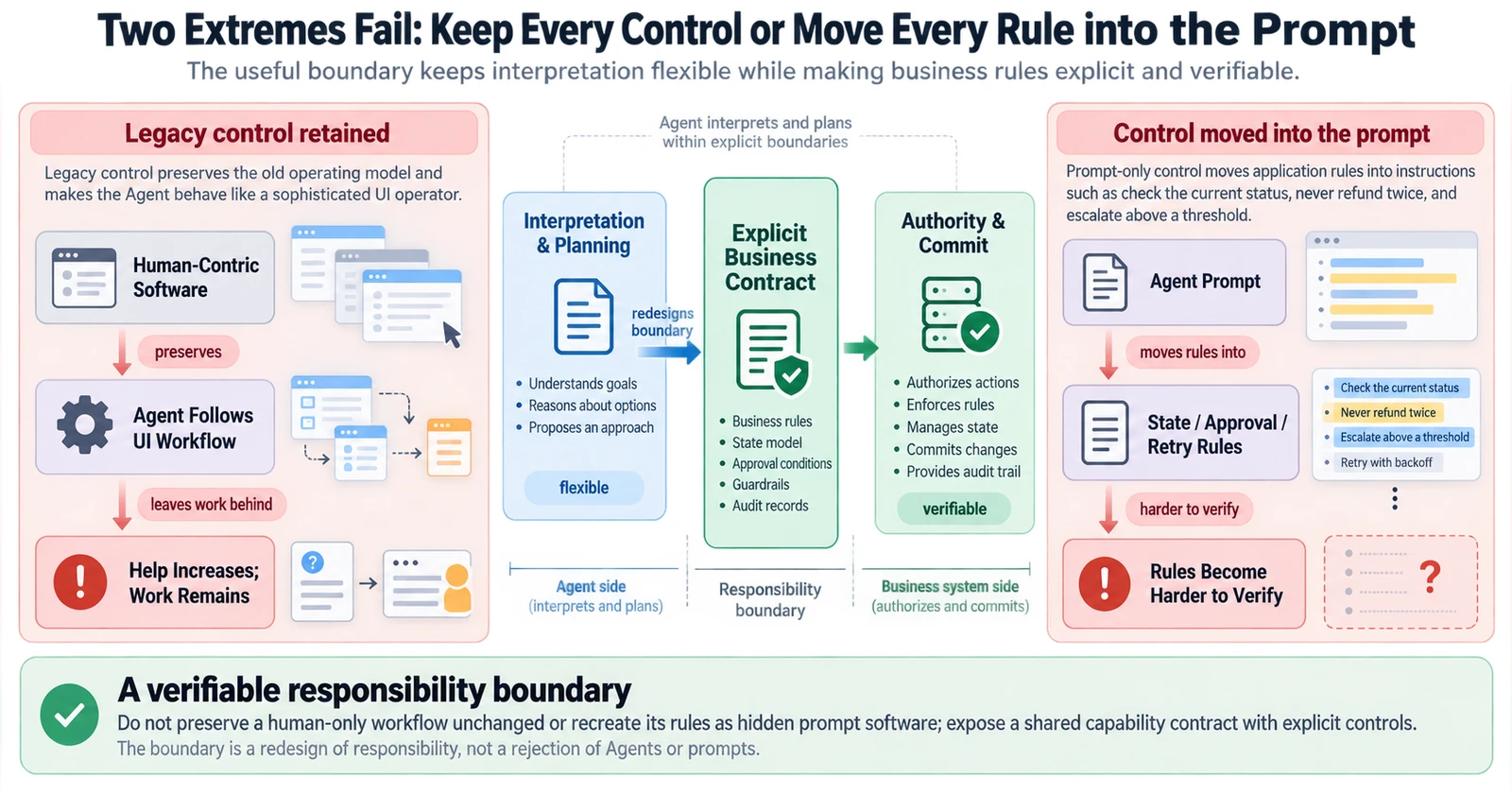
Put an Agent in Front of Existing Software, and It May Help Without Removing Work
There is an opposite failure mode.
What if we keep the existing enterprise application exactly as it is and simply put an agent in front of it?
That sounds safer, and it often is the easiest first implementation. But much enterprise software assumes that a human will navigate a UI.
A user opens a screen, enters data, passes validation, requests approval, another user approves it, and a final screen performs the mutation. Authorization and business rules are scattered behind buttons, modals, controllers, and workflow steps.
Add an agent in front of that architecture and a familiar user experience appears.
The user says, “Refund this customer.”
The agent finds the customer, locates the order, summarizes the reason, and prepares the request. But the system still requires a case to be created, a manager to approve it, Finance to verify it, and a human to complete the refund screen.
The agent begins responding:
“The request is ready.”
“Manager approval is required.”
“We are waiting for Finance.”
“The next step must be completed by the owner.”
The agent is clearly useful. Search is faster. Documents are better. Context is easier to gather.
But the user’s reaction may still be:
It helps with my work, but it does not remove much of my work.
The agent is still walking through a workflow designed around a human user.
A serious enterprise-agent architecture therefore cannot stop at adding a conversational layer. Human-UI-centric applications eventually need to expose business capabilities in forms that humans, agents, and automations can share.
Remove the Controls Instead, and the Software Reappears Inside the Prompt
After experiencing that limitation, teams can overcorrect in the other direction.
“Let the agent decide approvals.”
“Let memory hold the state.”
“If something fails, let the agent retry.”
The system suddenly feels far more flexible. The agent receives a goal, reasons, selects a tool, observes the result, and chooses another action.
Then the prompt starts growing:
Do not refund twice.
Always check the current status first.
Never proceed without manager approval.
If the amount exceeds X, escalate.
If the API times out, verify whether the operation already succeeded.
Those rules are familiar because they used to live in application code and workflow logic.
My rule of thumb is simple:
If you remove the workflow and then rewrite its rules inside the prompt, you did not eliminate software. You moved it somewhere that is harder to verify.
A 2024 study on neuro-symbolic generative agents offers a useful supporting example. By combining LLM generation with a formal automaton enforcing temporal structure, the system achieved substantially higher procedural-constraint adherence than a pure LLM approach. The domain was interactive storytelling, not enterprise transactions, so the result should not be overstated. But it illustrates why explicit state and procedural control remain active research topics. Procedural Adherence and Interpretability Through Neuro-Symbolic Generative Agents
Even a Personal Assistant Becomes Stateful Once It Changes the World
This is not only an enterprise problem.
Ask a personal assistant:
“Set up dinner with John next Tuesday.”
That sounds like a task one autonomous agent should handle easily. But the moment the agent interacts with a real calendar, states emerge:
Proposed → Invite Sent → Waiting → Accepted.
Before the process finishes, the user may say, “Actually, move it to Wednesday.” John may already have accepted. Another event may have taken the Wednesday slot.
The agent cannot safely trust its conversational memory as the current truth. It has to read the committed state of the calendar.
Should it cancel an existing event, update the current invitation, or create a new one? The answer depends on real state, not on the agent’s recollection of its previous reasoning.
If a personal assistant already encounters this problem, enterprise systems amplify it.
There may be Human A, Human B, Agent A, Agent B, CRM, ERP, a payment provider, and a document system all touching related business objects.
At that point, the hard question is no longer “Which agent is smarter?”
It is:
Who defines the current state, and who is authorized to move it?
A larger model does not make that question disappear.
Reallocate Responsibilities Instead of Choosing Agent or Software
This is why I do not frame the architecture as Agent vs Software.
Agents are particularly good at semantic uncertainty:
- understanding intent,
- comparing documents,
- classifying,
- planning,
- selecting among candidate actions,
- interpreting exceptional context.
Applications and runtimes are better places to own a different class of responsibility:
- Identity,
- Committed State,
- Authorization,
- Policy,
- Legal Transition,
- Persistence,
- Idempotency,
- Commit,
- Readback,
- Audit,
- Replay.
The fact that an agent can call refund_order does not imply that the agent is authorized to execute this refund.
A tool represents capability. Authority is another concern.
This separation is not about weakening the agent. It is often what allows the agent to remove more work. The model no longer needs to re-reason about rules that the business has already decided deterministically. It can focus on the parts that actually require interpretation.
Existing Software Must Change Too
This argument should not be mistaken for “keep the old software exactly as it is.”
I think the opposite is true.
Much enterprise software is UI-centric. A business capability such as Approve Discount may not exist as a clean contract. Instead, it is scattered across a particular screen, button, modal, controller, and approval workflow.
That was workable when humans were the only first-class actors.
Agents change the requirement.
A Human UI, an Agent, and a Batch Automation should be able to invoke the same business capability. Beneath that capability, the same State, Policy, Authority, and Constraint should apply regardless of caller.
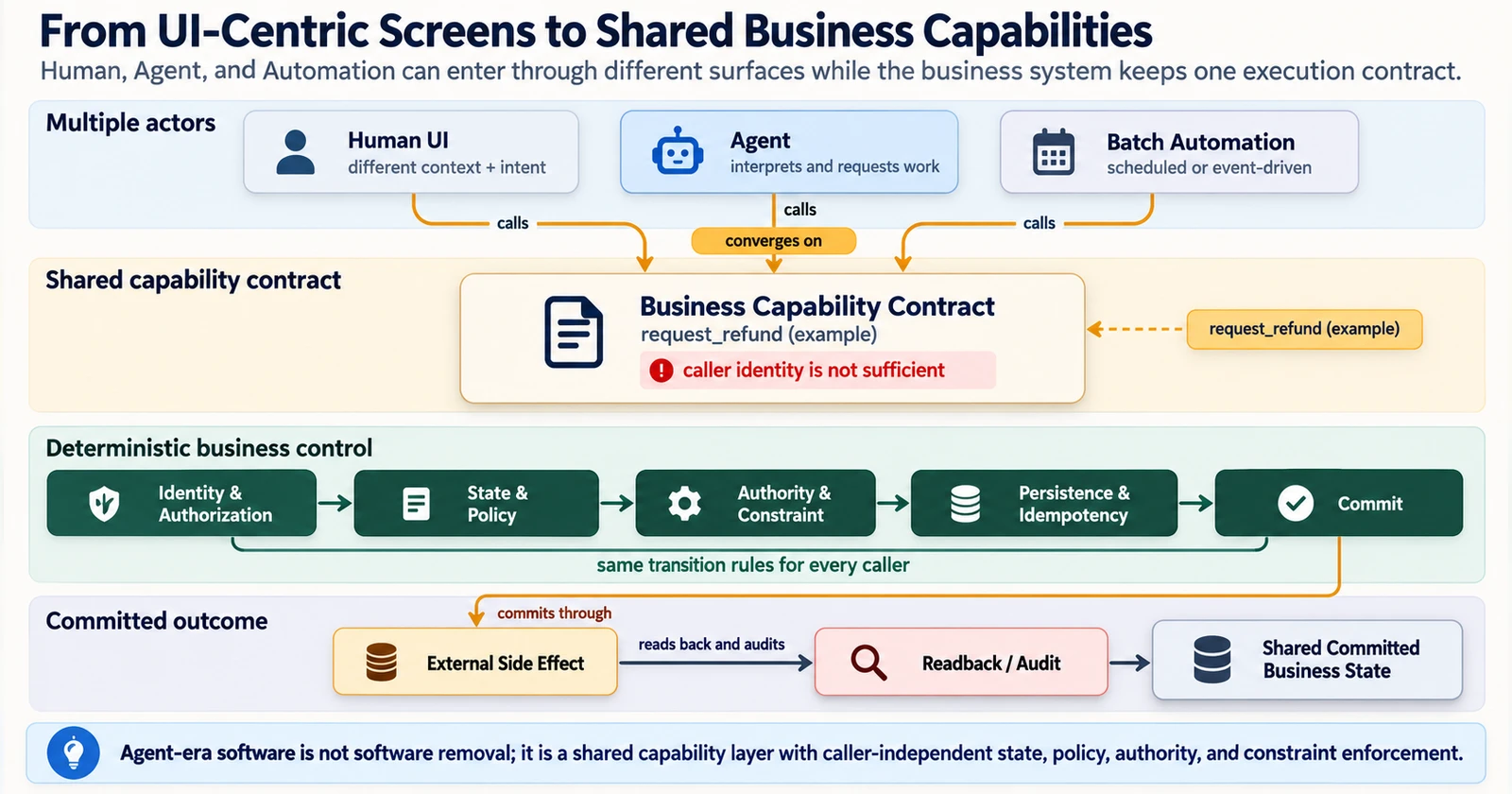
In that architecture, an agent is no longer a sophisticated RPA system imitating human screens.
It understands context, selects the right capability, constructs the request, and interprets the outcome.
The business system protects the shared reality.
That is a much more plausible Agentic Enterprise Architecture.
So Will n8n, Make, and Zapier Disappear?
They might. At least their current mode of use may change dramatically.
That is not the important question.
n8n’s own 2026 direction is interesting precisely because it reflects this transition. n8n Assistant can author, run, and repair workflows from natural language, yet the output remains a workflow that a team can inspect, edit, and observe through execution logs.
n8n Agents let an agent use workflows as tools, while workflows can call an agent when a semantic step is needed.
That does not prove that n8n will exist forever.
What it shows is more useful: as agents improve, a workflow product does not necessarily throw workflows away. Instead, authoring and semantic decisions become more agentic while explicit execution structures remain available.
Tomorrow an agent may generate TypeScript directly. It may create a workflow definition that no human ever draws on a canvas.
Once that code runs, however, somebody still has to answer:
What is the current state?
Is this transition legal?
Who has the authority to execute it?
Did the external side effect actually happen?
What happens if the request is repeated?
What evidence must be retained?
Removing the UI does not remove those questions.
Why Software Engineering May Matter More in the Agent Era
Traditional software placed both decisions and execution in code.
Agents are redrawing that boundary.
Interpretation, contextual judgment, and candidate action generation increasingly move toward the model.
Shared state and authority over the real world remain in software.
A good agentic architecture does not eliminate one side. It reallocates responsibility to the side that can own it reliably.
That is why I find a different question more useful than “Will agents kill workflow engines?”
Which judgments should move to the agent, and which facts and rules should remain explicit software?
The fact that an agent can call APIs well is not a reason to discard decades of lessons about state machines, transactions, authorization, concurrency, and audit.
If rewriting those lessons as prompt instructions were enough, software engineering would have become much easier a long time ago.
A good enterprise agent does not eliminate software. It stops re-reasoning about what software already does well and takes responsibility for the ambiguity software has historically handled poorly.