Skip to content
Peter's Stack
  • Home
  • About
  • Topics
  • Privacy
  • Contact
  • 한국어

The AI Code Review Bottleneck: Why Does Faster Code Generation Create More Work?
October 14, 2026 by Peter
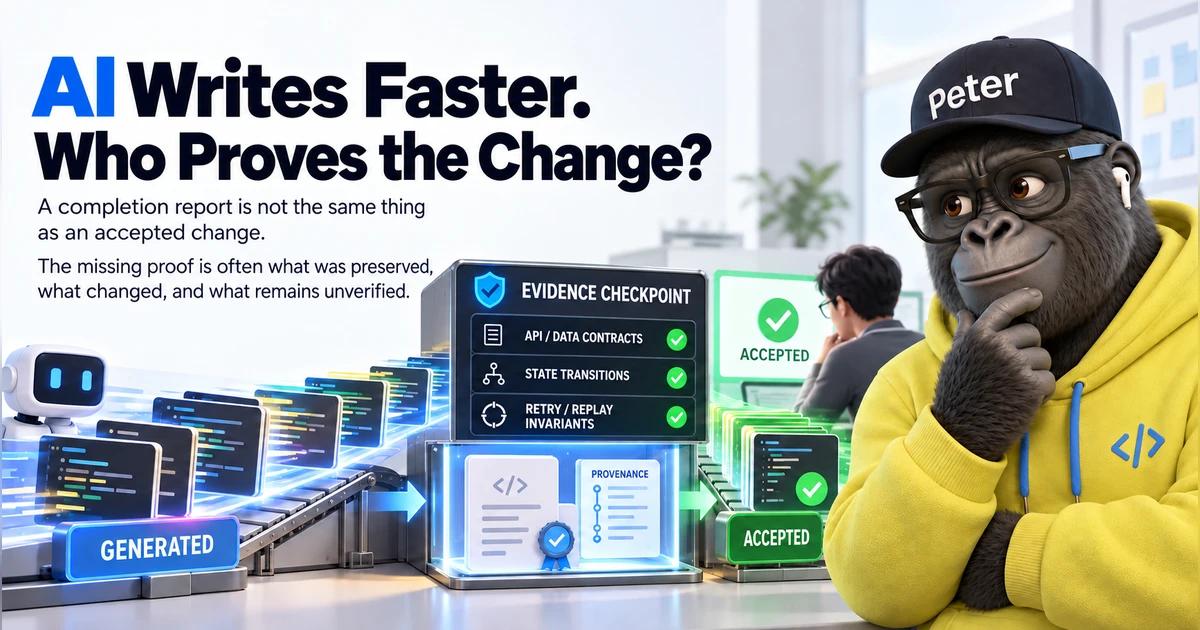
Cards of generated code move toward an evidence checkpoint listing API and data contracts, state transitions, and Retry/Replay invariants, then continue to human acceptance and accepted changes beside Peter.

Why AI-generated changes still create review work even with spec-driven development: proof burden shift, enterprise constraints, auditor fatigue, and invariant-first acceptance.
Categories Enterprise AI Tags AI Code Review, Coding Agents

Why Did the Same Decision API Produce Different Answers? Question Engineering with Microsoft Decision-1 and JEV

October 12, 2026 by Peter
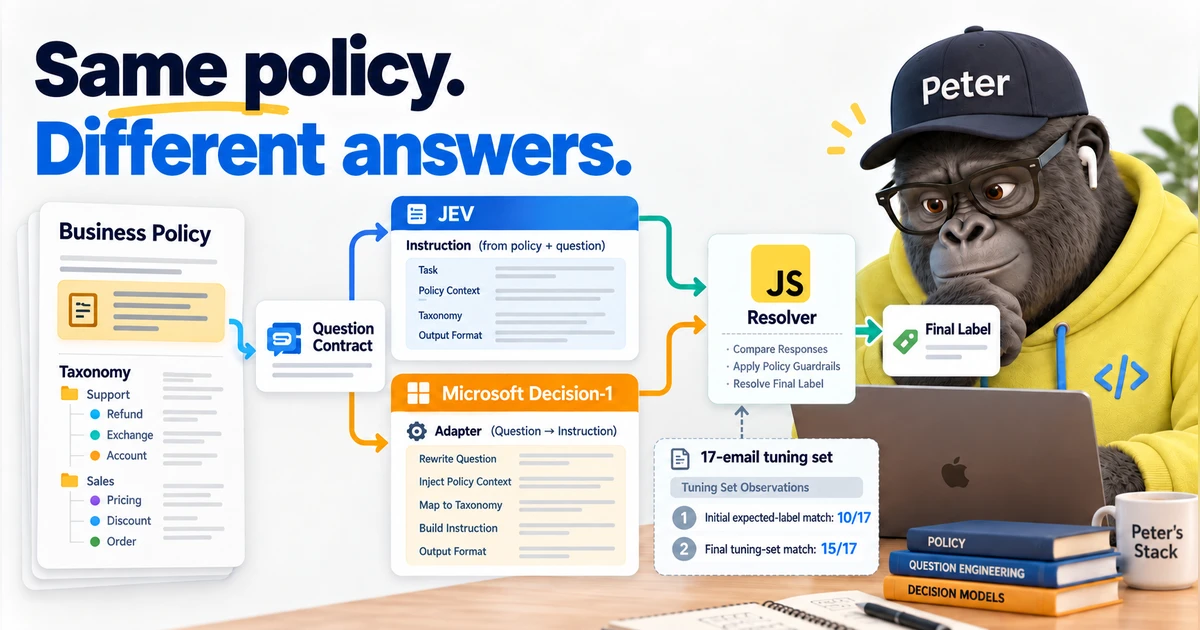
A workbench diagram shows one Business Policy and Taxonomy splitting into JEV and Microsoft Decision-1 question contracts and adapters, then converging at a JavaScript Resolver and final label. A 17-email tuning-set card marks initial 10/17 and final 15/17 matches.

Porting a JEV email classifier to Microsoft Decision-1 exposed an adapter bug, conflicting business boundaries, and regressions across seven tests.

Categories Enterprise AI Tags JEV, Microsoft Decision-1, Question Engineering

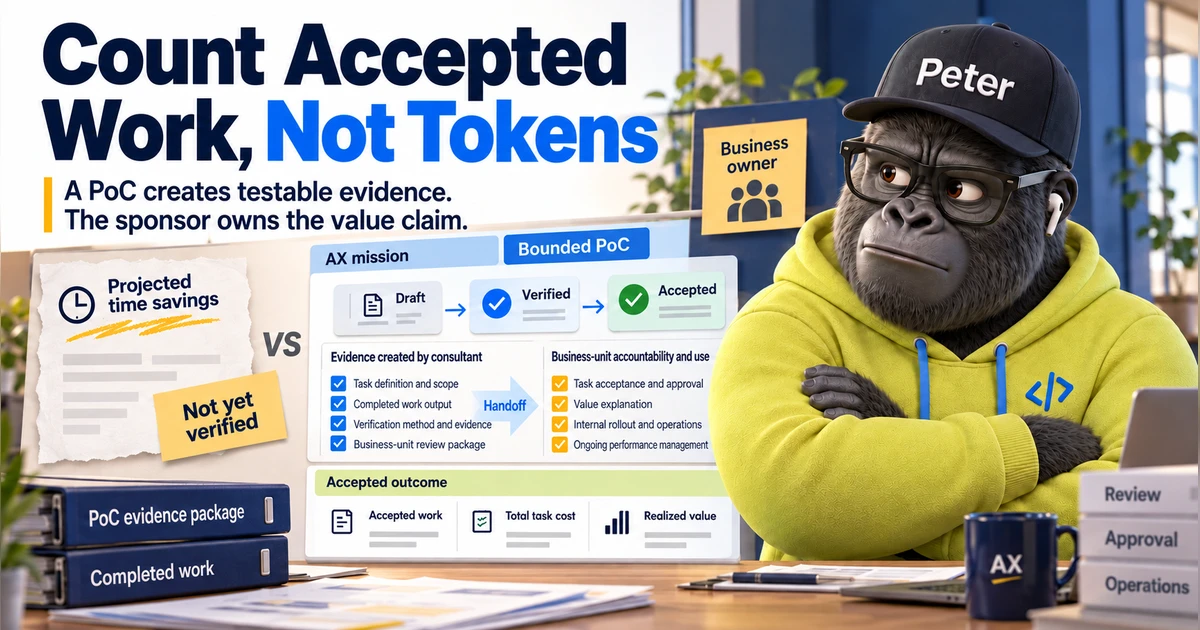
How Should Enterprises Calculate AI ROI? Measure Cost per Accepted Business Outcome, Not Token Spend

October 12, 2026 by Peter
A glasses-wearing gorilla character sits beside a visual board showing an AX mission, a bounded PoC moving from Draft to Verified to Accepted, projected time savings marked not yet verified, sponsor accountability, and accepted work, total task cost, and realized value.

How a business-unit sponsor can prove enterprise AI value through bounded PoCs, accepted outcomes and full workflow unit economics.

Categories Enterprise AI Tags AI PoC, AI ROI

Why Can Agent Skills Reduce Performance? Lessons from Microsoft Research and Enterprise AI

October 11, 2026 by Peter
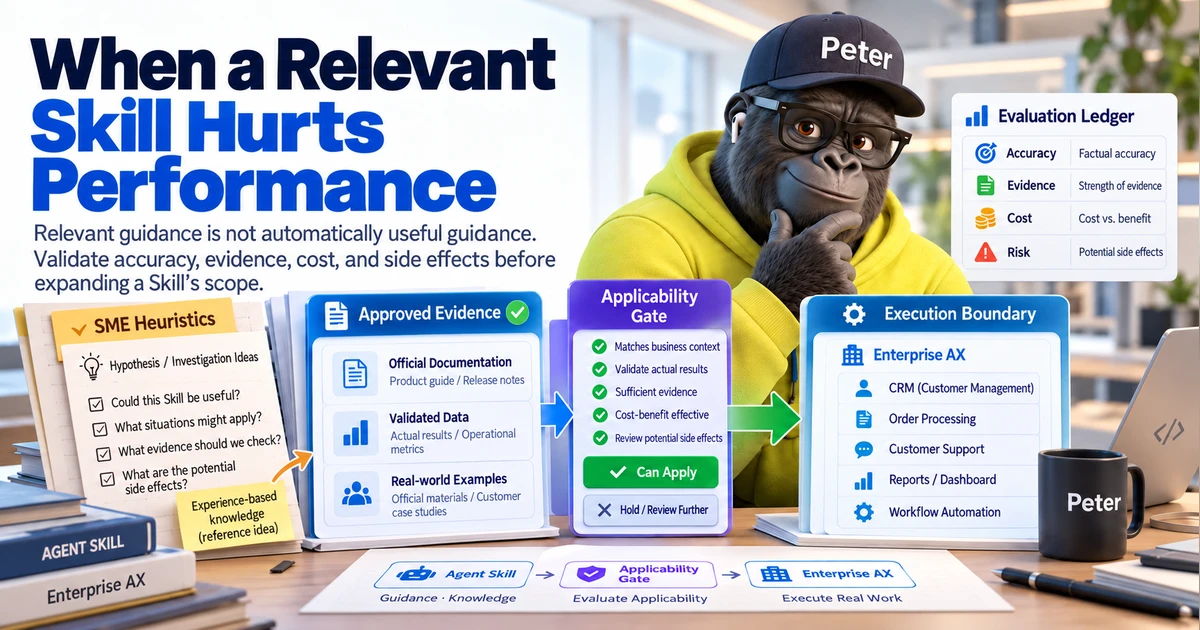
Peter examines an evaluation setup at a desk linking SME Heuristics, Approved Evidence, an Applicability Gate, and an Execution Boundary. An evaluation ledger lists accuracy, evidence, cost, and risk.

A practical look at Microsoft’s Skill-induced failure findings and how to evaluate SME knowledge, evidence authority, scope, and cost in enterprise agents.

Categories Enterprise AI Tags Agent Skills, Enterprise AI

Agent Skills vs MCP: How SKILL.md Changes the Way AI Agents Work

October 8, 2026 by Peter
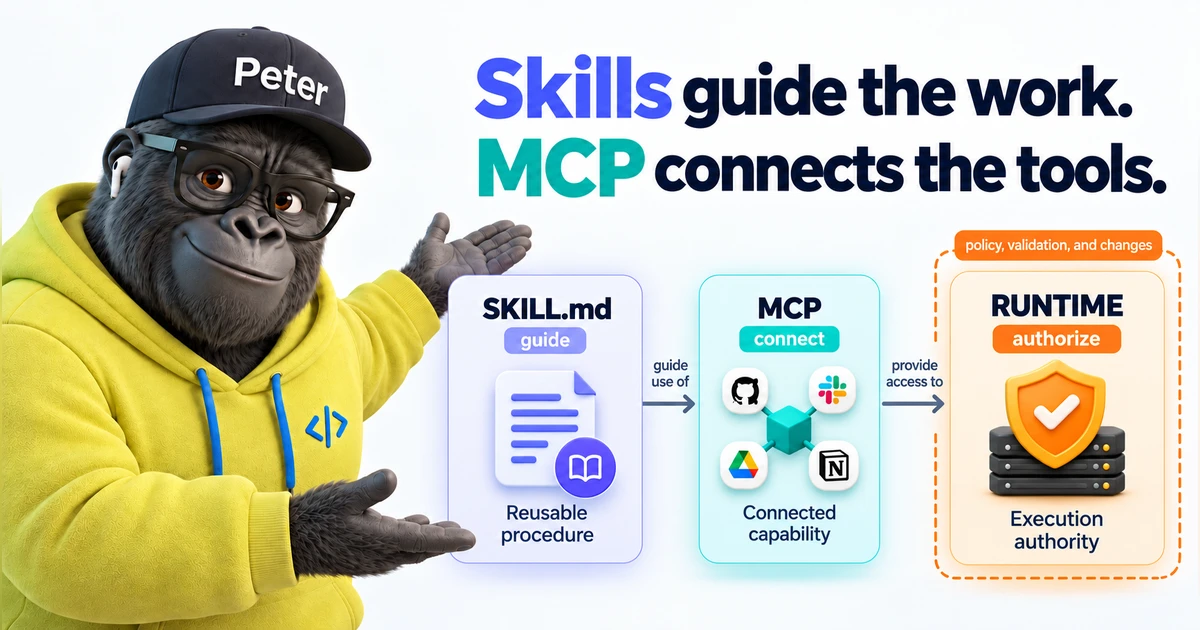
A gorilla named Peter in a yellow hoodie gestures toward three cards labeled SKILL.md, MCP, and RUNTIME. Skill guides reusable work, MCP connects capabilities, and Runtime holds authority for execution and approval.

What Agent Skills and SKILL.md do, how they differ from MCP, and how enterprise domain experts can turn practical review know-how into reusable guidance without replacing runtime controls.

Categories Enterprise AI Tags Agent Skills, Enterprise AI, MCP, SKILL.md
Older posts
Page1 Page2 … Page6 Next →

Recent Posts

  • The AI Code Review Bottleneck: Why Does Faster Code Generation Create More Work?
  • Why Did the Same Decision API Produce Different Answers? Question Engineering with Microsoft Decision-1 and JEV
  • How Should Enterprises Calculate AI ROI? Measure Cost per Accepted Business Outcome, Not Token Spend
  • Why Can Agent Skills Reduce Performance? Lessons from Microsoft Research and Enterprise AI
  • Agent Skills vs MCP: How SKILL.md Changes the Way AI Agents Work
© 2026 Peter's Stack · About · Contact · Privacy Policy