Skip to content
Peter's Stack
  • Home
  • About
  • Topics
  • Privacy
  • Contact
  • 한국어

Enterprise AI

Why Can Agent Skills Reduce Performance? Lessons from Microsoft Research and Enterprise AI
October 11, 2026 by Peter
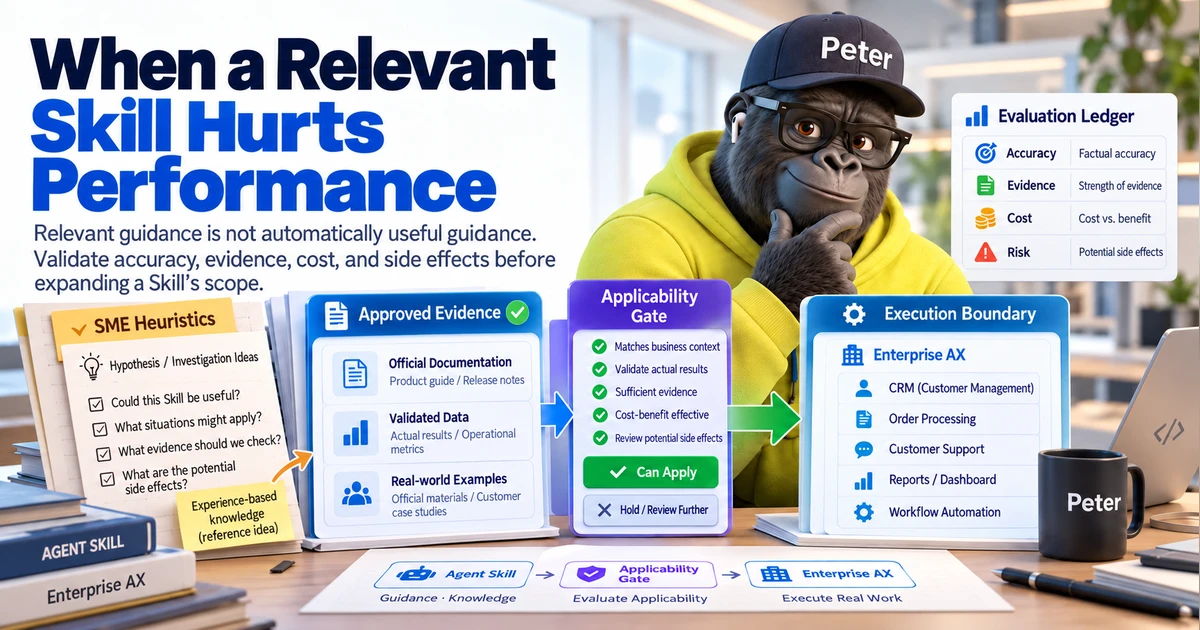
Peter examines an evaluation setup at a desk linking SME Heuristics, Approved Evidence, an Applicability Gate, and an Execution Boundary. An evaluation ledger lists accuracy, evidence, cost, and risk.

A practical look at Microsoft’s Skill-induced failure findings and how to evaluate SME knowledge, evidence authority, scope, and cost in enterprise agents.
Categories Enterprise AI Tags Agent Skills, Enterprise AI

Agent Skills vs MCP: How SKILL.md Changes the Way AI Agents Work

October 8, 2026 by Peter
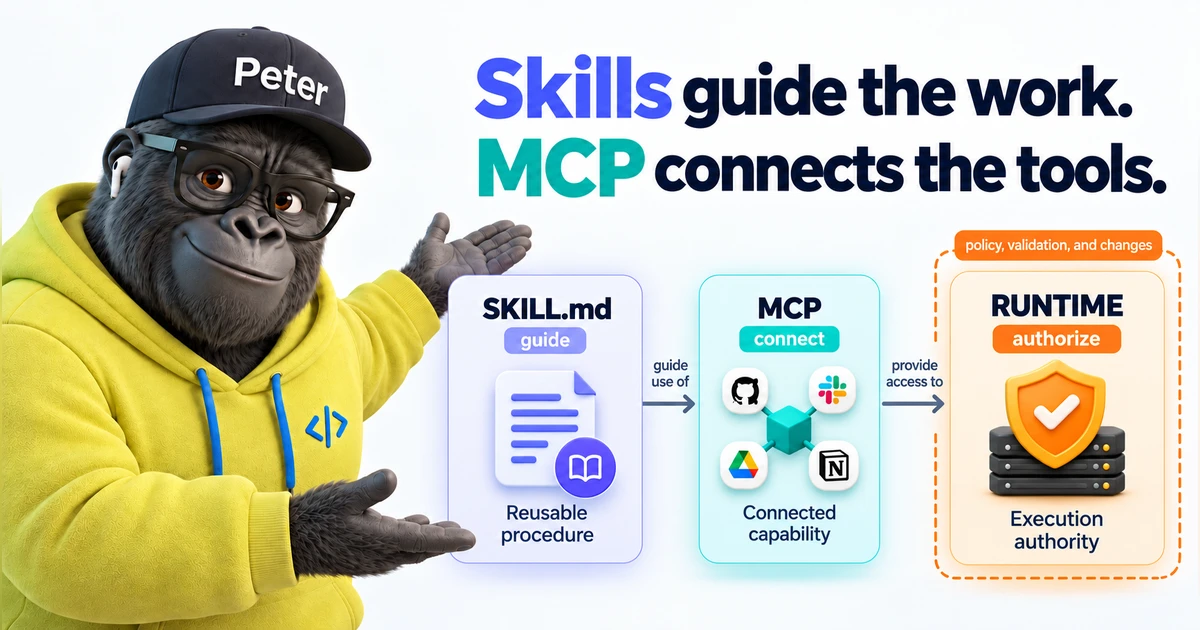
A gorilla named Peter in a yellow hoodie gestures toward three cards labeled SKILL.md, MCP, and RUNTIME. Skill guides reusable work, MCP connects capabilities, and Runtime holds authority for execution and approval.

What Agent Skills and SKILL.md do, how they differ from MCP, and how enterprise domain experts can turn practical review know-how into reusable guidance without replacing runtime controls.

Categories Enterprise AI Tags Agent Skills, Enterprise AI, MCP, SKILL.md

What Enterprise AX Consultants Actually Do: Design Boundaries Before Choosing AI

October 8, 2026 by Peter
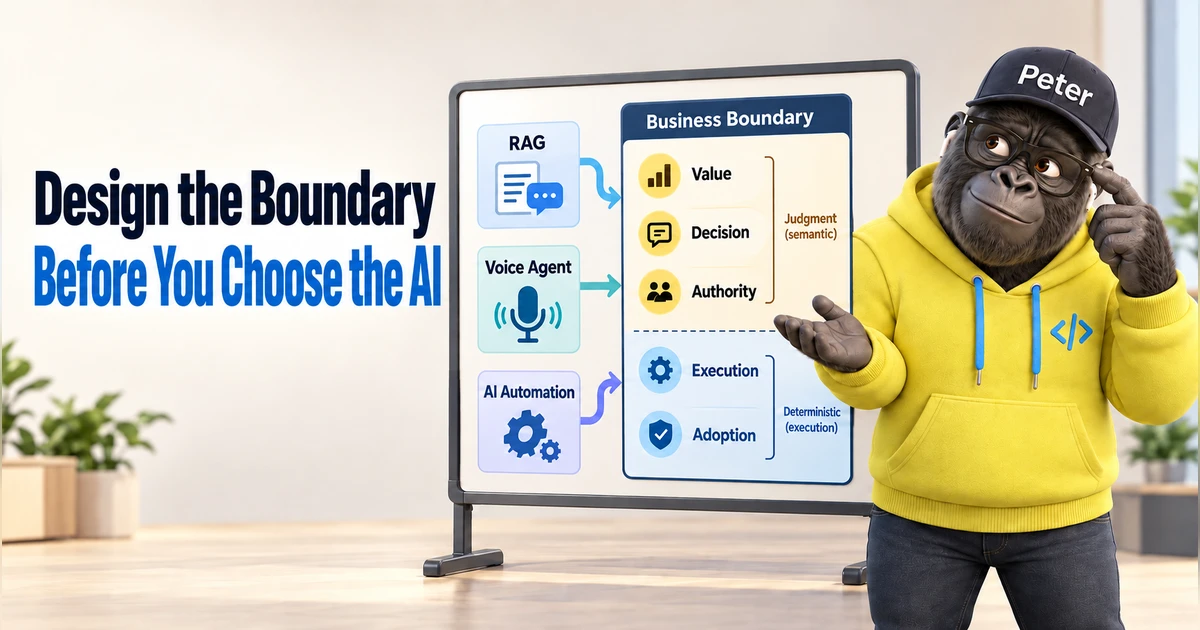
A gorilla character in a yellow hoodie and ‘Peter’ cap stands beside a Business Boundary board connecting RAG, Voice Agent, and AI Automation to Value, Decision, Authority, Execution, and Adoption.

Lessons from RAG, voice-agent, and automation projects show that enterprise AI succeeds less by choosing the newest technology than by defining Value, Decision, Authority, Execution, and Adoption boundaries that survive production.

Categories Enterprise AI Tags AI Agent, AI Governance, Enterprise AI, Enterprise AX, Human in the Loop

When Web Search Becomes Strategy Validation: Using a Market Lens to Pinpoint Research from an RFP

October 4, 2026 by Peter
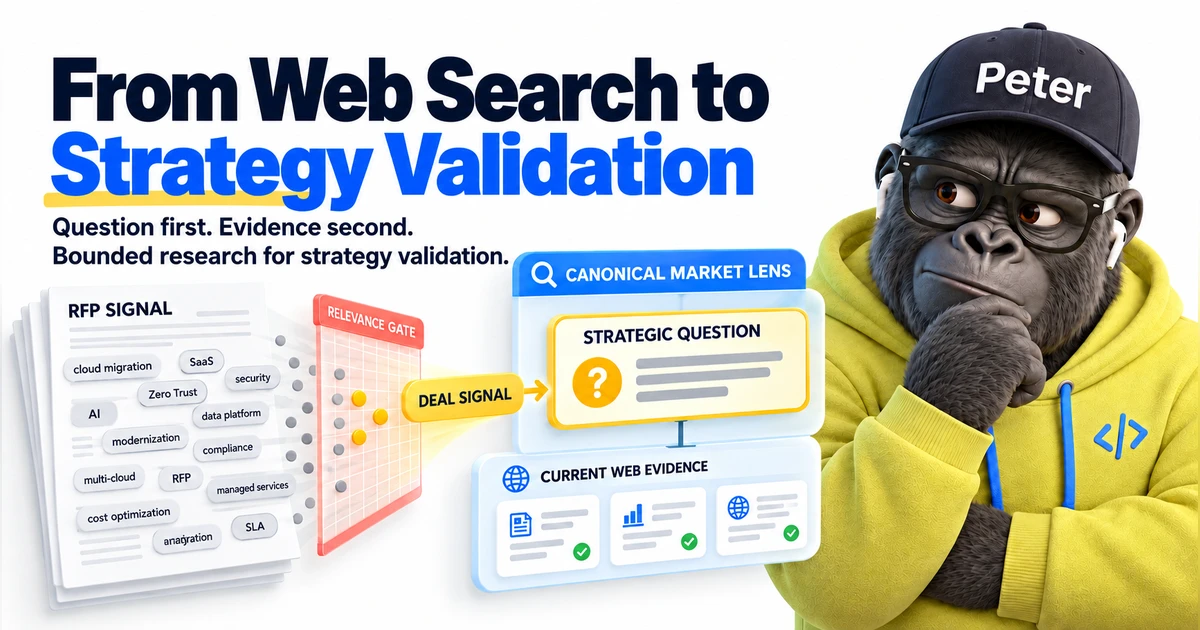
An RFP SIGNAL document with varied technical terms narrows through a RELEVANCE GATE and DEAL SIGNAL into a CANONICAL MARKET LENS containing a STRATEGIC QUESTION and CURRENT WEB EVIDENCE, while Peter observes on the right.

Instead of expanding RFP keywords into broad searches, combine Deal Signals with a Canonical Market Lens, define the evidence required, and use Web Search to validate strategy-relevant deltas.

Categories Enterprise AI Tags Context Engineering, Enterprise AI, Market Intelligence, RFP, Web Search Agent

Teaching a Web Search Agent How Your Company Sees the Market: Canonical Market Lens and the LLM Wiki

October 4, 2026 by Peter
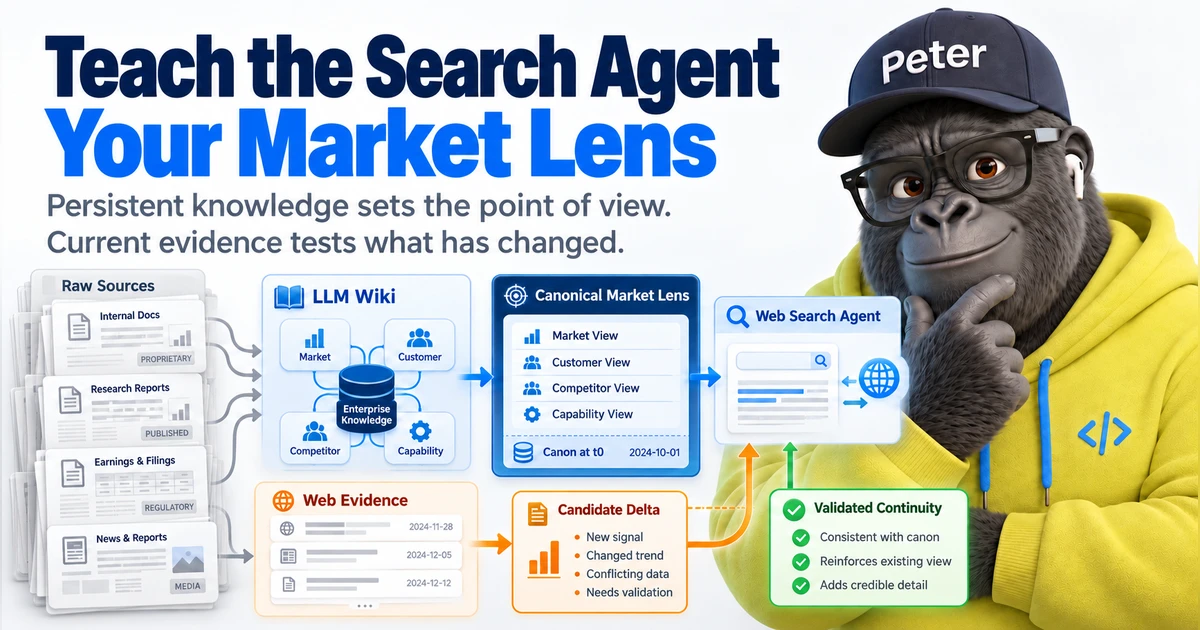
A layered architecture shows enterprise documents and research flowing into an LLM Wiki, then a Canonical Market Lens and Web Search Agent. A separate Web Evidence stream enters a Candidate Delta and validated continuity path, with the Peter gorilla character on the right.

Instead of re-injecting market reports, competitor research, and company capabilities into every prompt, maintain them in an LLM Wiki and compile a reusable Canonical Market Lens for enterprise Web Search.

Categories Enterprise AI Tags Context Engineering, Enterprise AI, LLM Wiki, Market Intelligence, Web Search Agent

Enterprise RAG Should Not Start with Search: Narrow the Retrieval Space with Deal Context First

October 4, 2026 by Peter
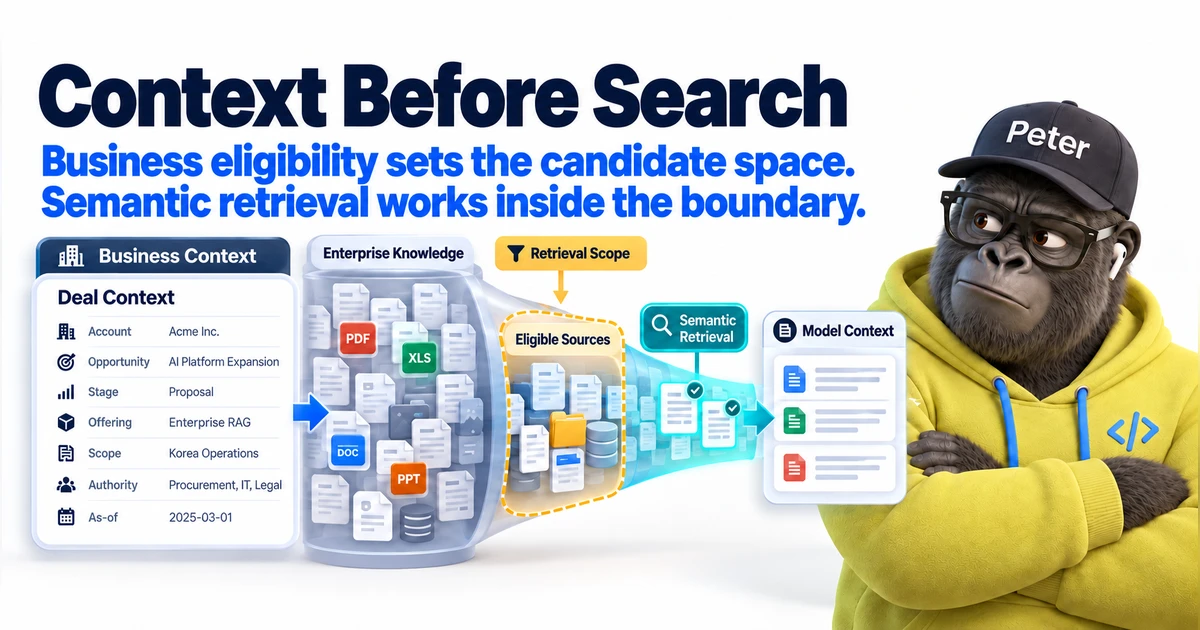
A Deal Context card narrows an Enterprise Knowledge document store through Retrieval Scope and Eligible Sources, then passes selected material through Semantic Retrieval into Model Context, with Peter beside the funnel.

Enterprise RAG needs a business-valid retrieval scope before semantic ranking begins. This article explains how Deal Context and a Retrieval Scope Contract can constrain the candidate corpus before embeddings and rerankers do their work.

Categories Enterprise AI Tags Context Engineering, Deal Intelligence, Enterprise AI, Enterprise RAG, Retrieval

AI Says It’s 90% Confident. Should You Automate?

September 30, 2026 by Peter

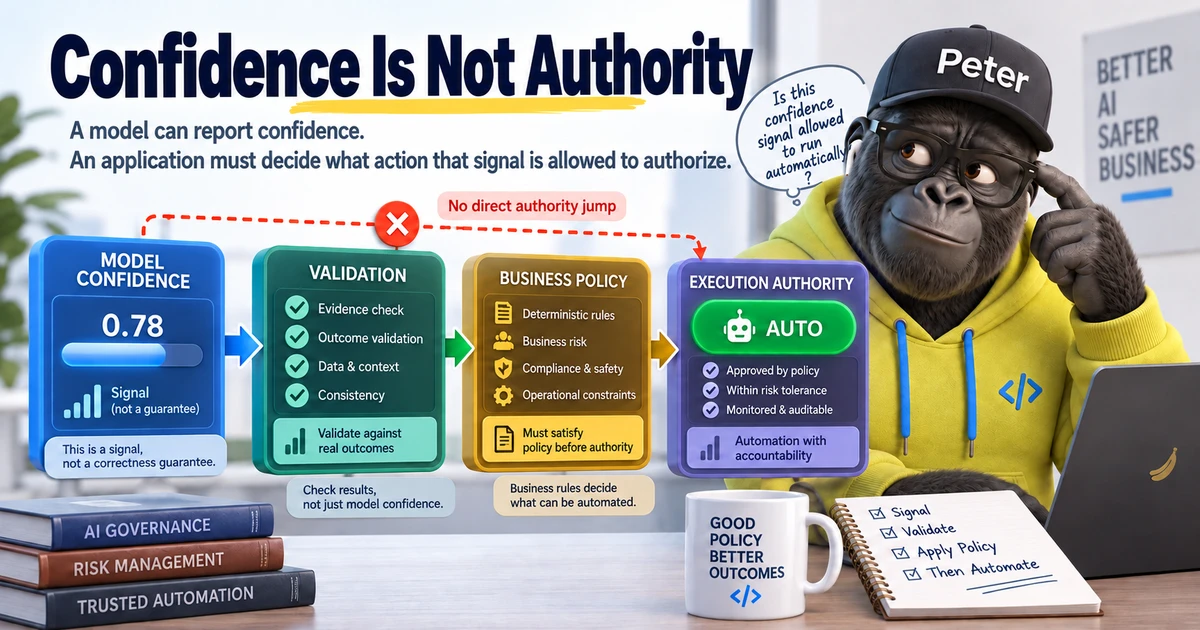
A confidence score makes an automation rule look easy. My JEV email classification PoC showed why the score must first be tested against outcomes and weighed against the consequences of a wrong decision.

Categories Enterprise AI Tags AI Confidence, Calibration, Enterprise AI, Human in the Loop, Salesforce

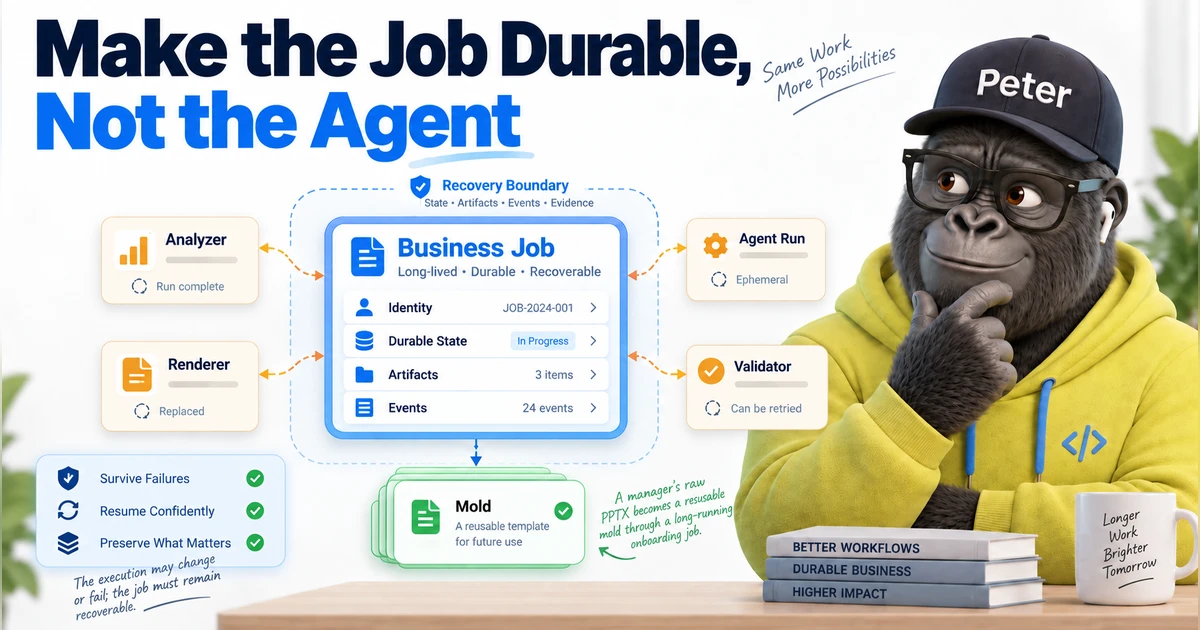
A Ten Minute Agent Task Exposed the Need for Durable Job State

September 28, 2026 by Peter

A manager’s PowerPoint template onboarding job reveals why an Agent Run cannot own the identity, state, and recovery of long running Enterprise AI work.

Categories Enterprise AI Tags Agent Runtime, Durable Workflow, Enterprise AI, Idempotency, Long-running Jobs

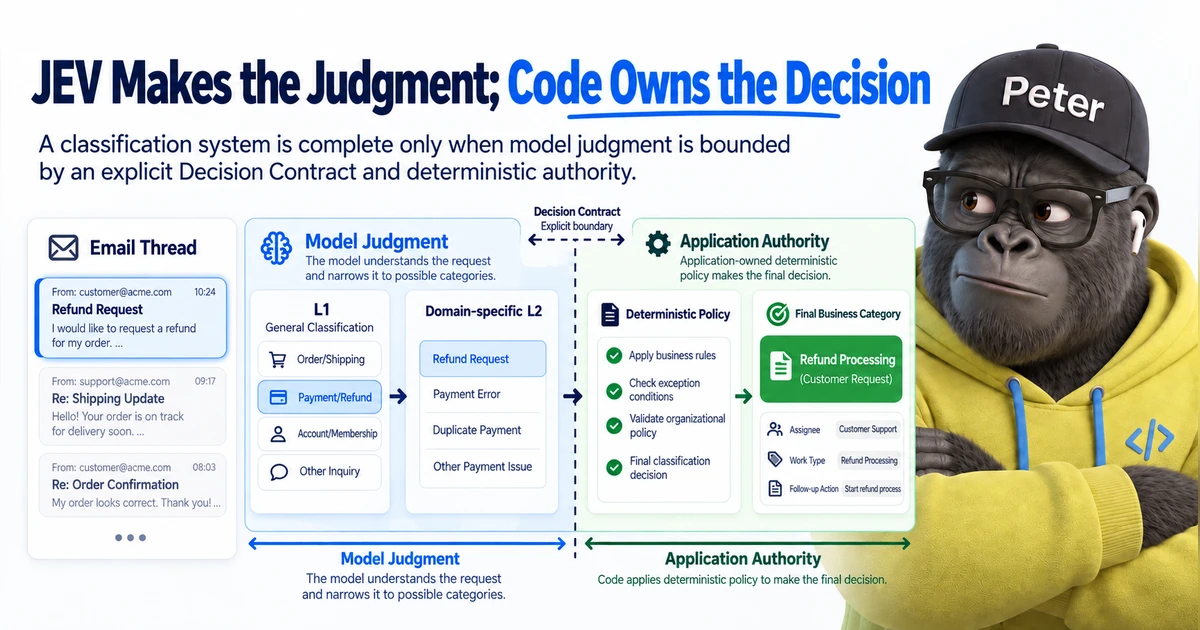
What Building an Email Classifier with JEV Taught Me About Decision Boundaries

September 28, 2026 by Peter

I built a JEV and n8n email classification PoC expecting to focus on model performance. The harder work was defining the active request, writing category boundaries, and deciding when a model judgment becomes a business decision.

Categories Enterprise AI Tags Decision Harness, Email Classification, Enterprise AI, JEV, n8n

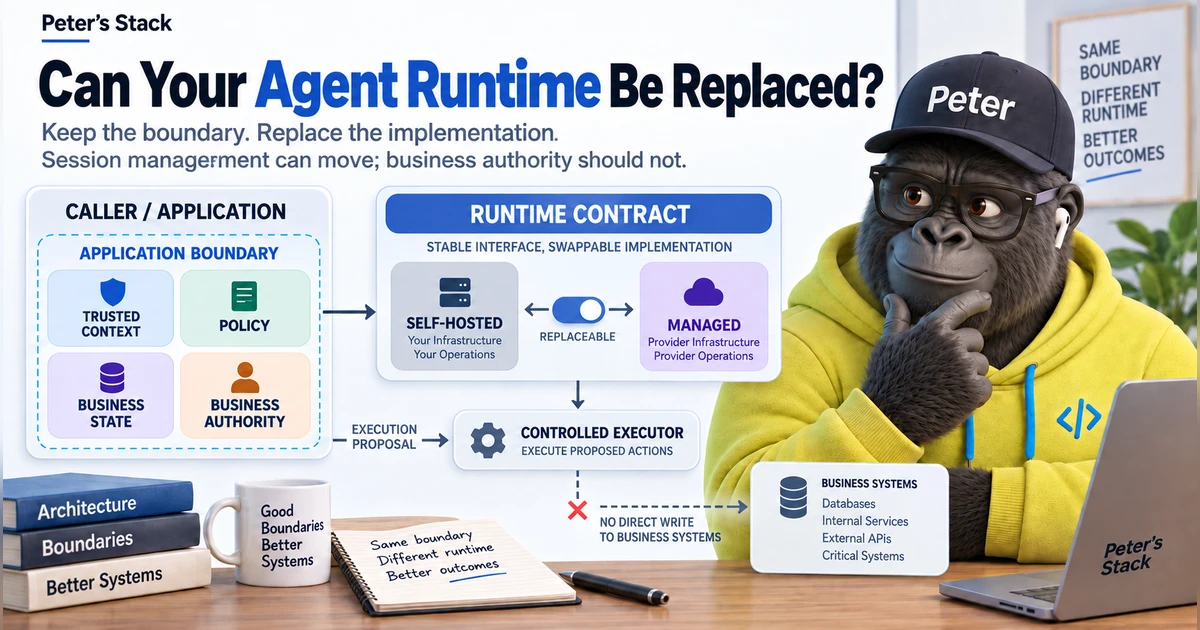
Do I Still Need My Agent Runtime Now That the Agents API Exists?

September 27, 2026 by Peter

OpenAI’s managed Codex harness can take over much of the work of running an agent. The harder question is which responsibilities still belong to the application, and how to make the runtime replaceable.

Categories Enterprise AI Tags Agent Runtime, Agents API, AI Architecture, Codex, Enterprise AI
Older posts
Page1 Page2 Next →

Recent Posts

  • The AI Code Review Bottleneck: Why Does Faster Code Generation Create More Work?
  • Why Did the Same Decision API Produce Different Answers? Question Engineering with Microsoft Decision-1 and JEV
  • How Should Enterprises Calculate AI ROI? Measure Cost per Accepted Business Outcome, Not Token Spend
  • Why Can Agent Skills Reduce Performance? Lessons from Microsoft Research and Enterprise AI
  • Agent Skills vs MCP: How SKILL.md Changes the Way AI Agents Work
© 2026 Peter's Stack · About · Contact · Privacy Policy