
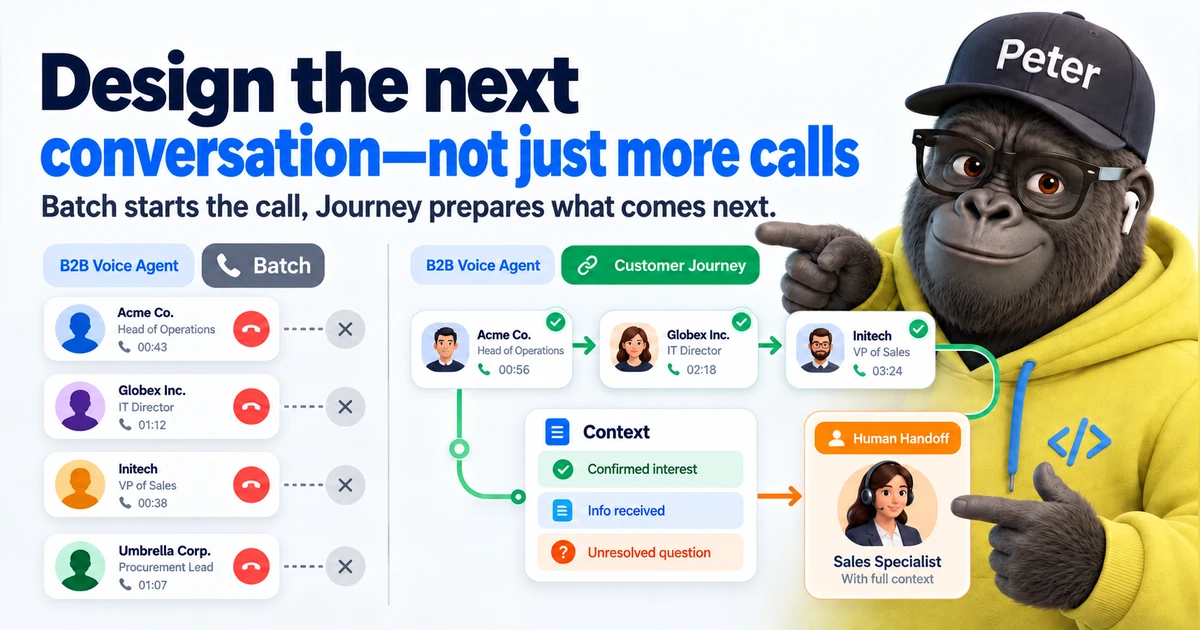
A single phone call rarely closes a B2B relationship.
A contact downloads a product brief, checks it with colleagues, and comes back with more specific questions. They may miss the first call, give you two minutes on the second, and ask for a technical specialist a week later. Anyone who has worked with enterprise customers has seen some version of this.
Now imagine asking a voice agent to handle those interactions. Placing an outbound call and following a short script is one thing. Picking up a relationship across several contacts is something else.
As I explored what an outbound voice agent could realistically do inside a business process, I became less interested in each call as an isolated event. I wanted to know what should happen on the next contact, what the customer had already told us, and whether a new response ought to change the plan. The more useful unit of design seemed to be the customer journey within a campaign, not the individual phone call.
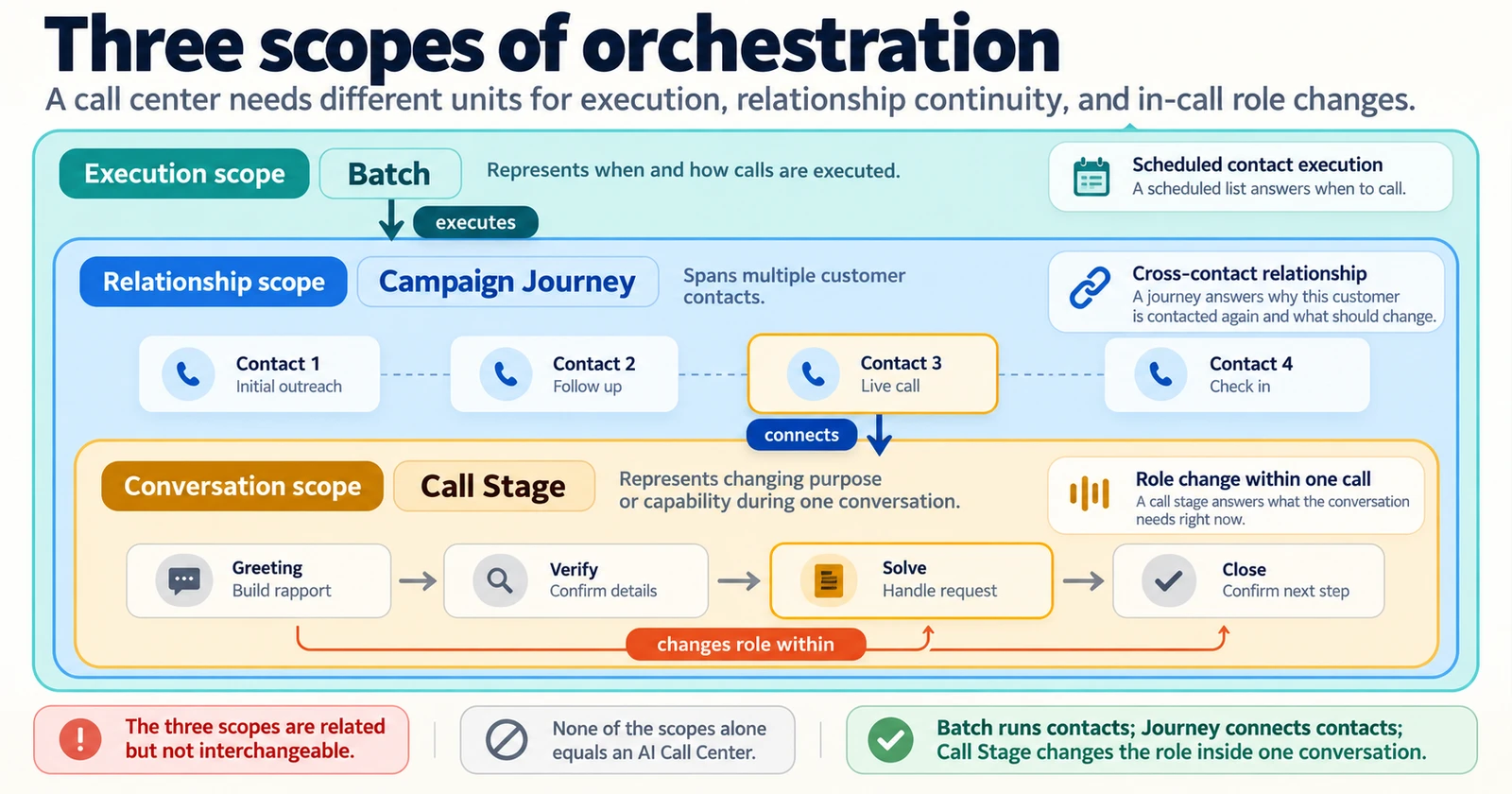
A batch of calls is not yet a call center
Consider an illustrative B2B campaign, not a transcript from a real customer. Three contacts have asked about a business solution. One misses the first call. Another needs only a quick clarification. The third has already reviewed the basics and wants to discuss a technical requirement.
They may belong to the same campaign, but treating them as three identical conversations would miss the point.
This is where I separate a batch from a journey. A batch groups and manages call execution. A journey answers a different set of questions: why are we speaking to this contact, what has already happened, and what should be different about the next interaction?
A scheduler might be perfectly capable of launching a large number of calls. That says little about whether the business knows which conversation is appropriate for each customer. Scaling execution and managing a relationship are different jobs.
Retry and follow-up only sound similar
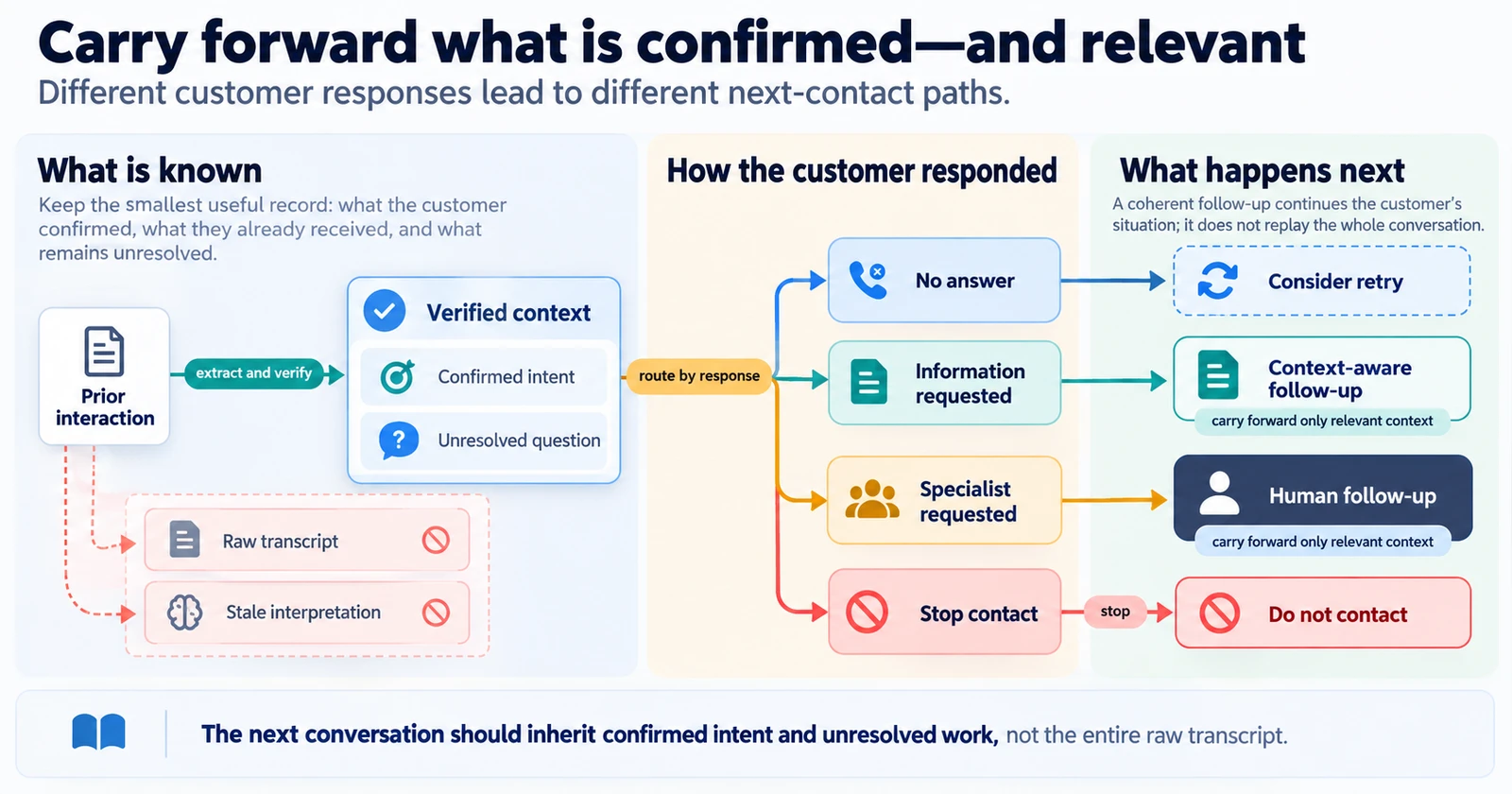
Suppose the first call goes unanswered. You may need to decide whether another attempt is appropriate. That is not the same as calling again because a customer explicitly asked for more information.
Take the same hypothetical contact. On a later call, they say they have seen the overview but need an internal technical review. If the next agent starts again with the opening product pitch, the conversation may sound smooth while the experience feels remarkably forgetful.
Customer responses ought to lead to different branches. No answer may justify checking retry eligibility. A request for documentation suggests a more focused follow-up. A request to speak to an engineer points toward a specialist. An instruction to stop contacting the person means stop.
None of this sounds especially clever when described by a human account manager. Automating it responsibly is another matter. Lead nurturing is not a competition to place more calls. It is a way to stay relevant as a customer’s interest develops.
The second conversation should not start from zero
Repeated contact produces a history: what was discussed, what the customer asked for, what remains unresolved, and what was promised for next time. Collecting that history is useful. Feeding every past transcript back into an agent is not necessarily useful.
A long transcript includes tentative remarks, information that may have changed, and personal details that have no business appearing in the next interaction. More importantly, the system must not confuse what the customer confirmed with what a model merely inferred.
I would rather give an agent a small, trustworthy briefing: the customer’s current area of interest, the information already provided, an unresolved question, and an agreed next step. That context should be purpose-limited, access-controlled, and revisable when new evidence arrives.
In this model, CRM is more than a final destination for call outcomes. It helps the next participant—human or AI—understand the same current customer situation. That is where continuity starts to feel like service rather than automation.
A single live call can change direction too
There is another kind of journey, much shorter than the campaign journey. It happens inside the conversation itself.
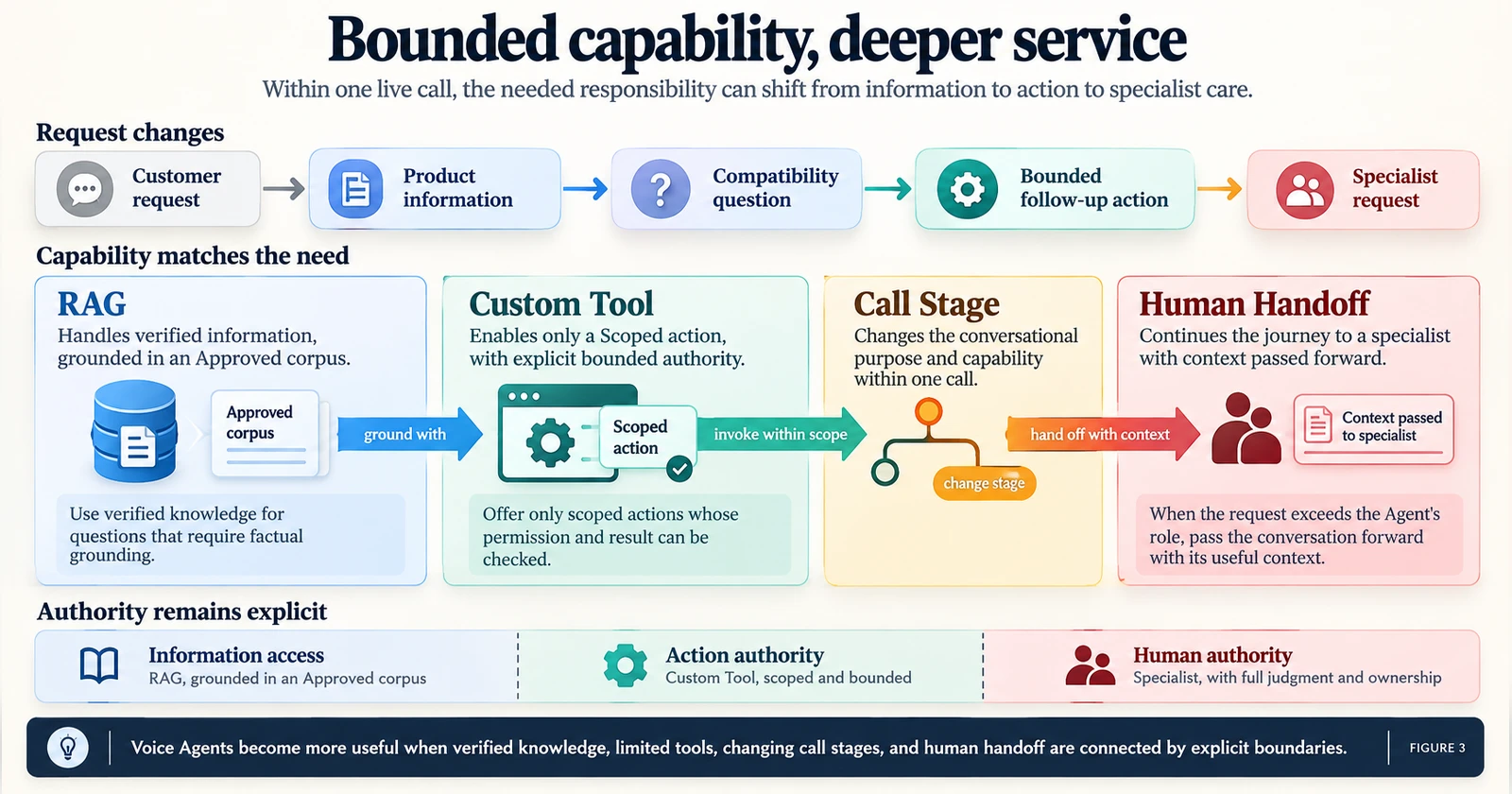
Someone begins with a broad product question and then asks about a specific compatibility issue. At that moment, fluent conversation matters less than reliable information. An agent may need to retrieve an approved document or consult a grounded corpus through RAG.
If the customer requests an operational step, a custom tool might help check information or propose a bounded action. But a tool being available is not permission to alter customer records or commit business changes. Reading information and taking action carry different consequences. Identity, scope, policy, and confirmation still matter.
Call Stages offer another design possibility. An opening stage may establish the customer’s purpose; a later stage may focus on factual questions; a more specialized request may need a different role or a human colleague. This is distinct from a campaign branch that determines what happens on the next call. It is a change of purpose and capability during one live conversation.
I would not make every simple call a multi-stage orchestration. Sometimes a short answer is all the customer needs. The value is having a way to change course when the conversation genuinely calls for it.
Let a person take over when that is better
In enterprise sales, that point is often easy to recognize. A standard product question turns into a discussion about the customer’s specific environment, commercial terms, or a decision requiring expertise.
When someone asks, “Could I speak to your technical team?”, more cheerful AI explanations are not an adequate substitute.
Transferring a call is only part of the handoff. The person receiving it should know why the customer called, what has been established, and what still needs an answer. If a live transfer is not available, a well-managed follow-up should preserve that context rather than send the customer back to the beginning.
I think of human handoff as part of the journey, not merely an emergency exit for a failing agent. Good service sometimes means knowing when to stop being the voice on the line.
A bigger AI call center requires a better operating model
Now imagine coordinating those journeys across a much larger campaign. Capacity and scheduling certainly matter. But every contact also has a current status, contact preferences, outstanding requests, and potentially a human conversation already in progress.
The system has to avoid duplicate outreach, respect contact restrictions, confirm what actually happened, and make exceptions visible. It also has to account for access to customer history, the availability of specialists, and the operational cost of handling work that does not fit a script.
Scale magnifies mistakes as effectively as it magnifies throughput. Misreading one short call is inconvenient. Repeating the same wrong follow-up decision across an entire campaign is something else.
That is why I hesitate to define an AI call center as simply a fleet of agents making calls. The more interesting architecture coordinates batches, customer journeys, contextual conversations, bounded capabilities, and the people who must sometimes step in.
I am not claiming that every part of this model has already been deployed and validated at scale. Its production readiness depends on testing and operational discipline. But the direction is worth exploring.
A B2B customer does not care how many agents are running behind the scenes. They notice immediately when they have to explain the same request all over again.
A good AI call center may ultimately be less about making more calls and more about being better prepared for the next conversation.