
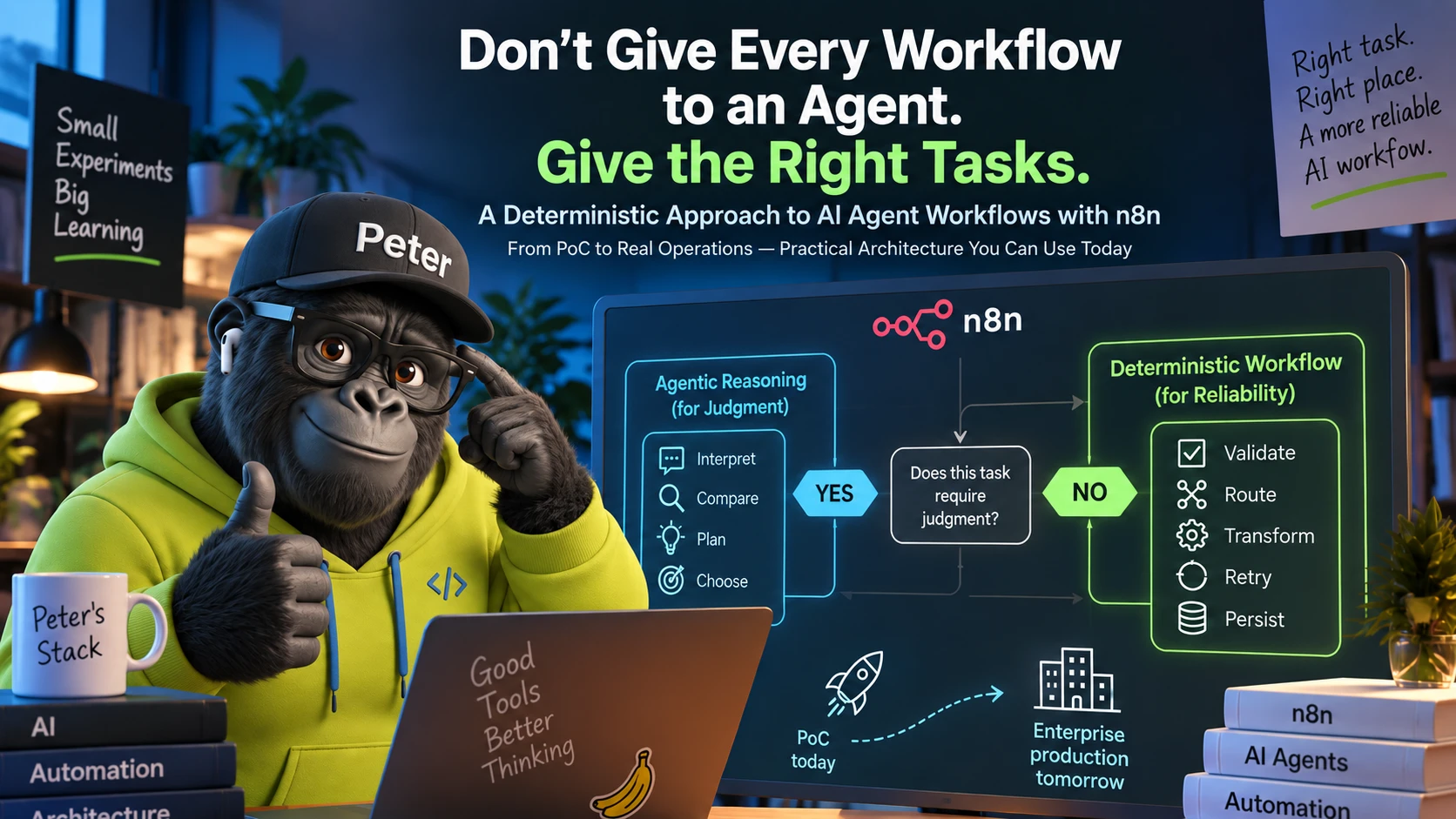
As reasoning models have improved and Coding Agents, MCP, Tool Calling, and different Agent Harnesses have emerged, I have repeated the same kind of experiment many times. I wanted to see how far an Agent could go if I gave it more Tools, let it plan and execute, and allowed it to carry a multi-step task forward on its own. In Vibe Coding, this already works surprisingly well: an Agent can read a repository, modify code, run tests, inspect a failure, and try again.
After enough of those experiments, a natural question appears.
Why not just let the Agent handle the entire business automation flow too?
The question changes once the Agent starts touching real customer processes and systems.
Wait. Did this step ever need the Agent to make a judgment in the first place?
What matters more to me now is not how much work an Agent can technically perform. It is where probabilistic judgment is actually useful, and where the same valid input and state should produce the same result every time. If that boundary is drawn poorly, even a strong model can leave the customer with a simple conclusion: “The AI is unreliable.”
Better Agents Make It Tempting to Delegate More
There are good reasons expectations around Agents keep rising. A Coding Agent can look at a goal and decide which files to inspect and what sequence of changes to make without having every step predefined. Personal-assistant-style Agents such as OpenClaw are also moving toward a model in which they connect to messaging channels, workspaces, and Tools, interpret a request, and choose the next Action. The OpenClaw documentation describes this kind of always-available personal AI assistant while also stressing conservative Tool Policy and Sandbox settings because connected Agents may be able to use files, commands, and messaging capabilities.
That kind of autonomy makes sense for many assistant tasks.
- Select the emails from today that deserve my attention.
- Review this week’s schedule and help me prioritize it.
- Read several documents and suggest what I should investigate next.
- Compare travel options and narrow the shortlist.
These requests involve interpretation and judgment. They do not have one fixed correct answer. There is a reason to spend reasoning tokens on reading Context and making a choice.
But not every task delegated to an assistant has that character.
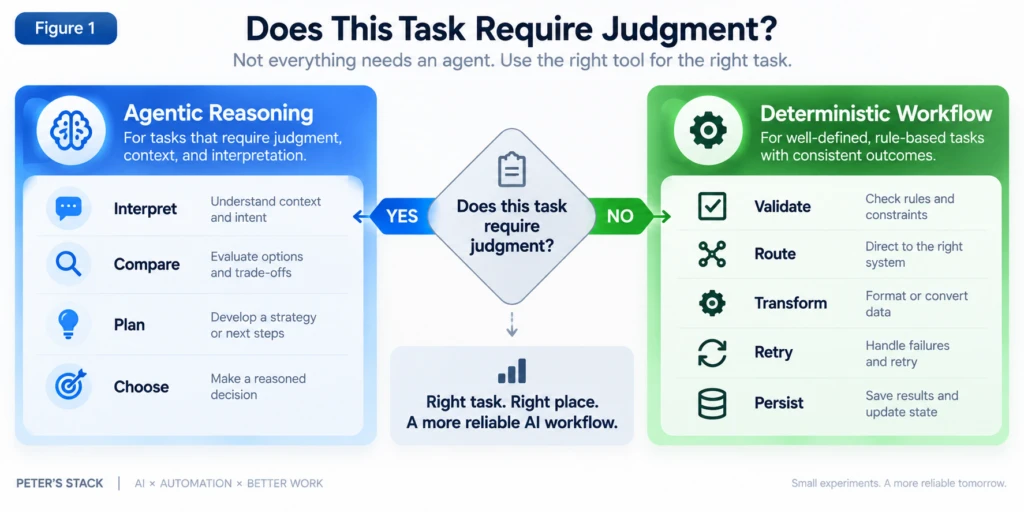
A request such as “Every day at 8 a.m., call this API, transform the result into this fixed format, and save it” is different. The desired behavior has already been agreed. The system should repeat it. There is little value in asking an LLM to reconsider the task and choose Tools again every morning. A Workflow composed of a Schedule Trigger, HTTP Request, Transform, and Persist step is faster, cheaper, and more predictable.
“Do it for me” and “think through it again every time” are not the same requirement.
Anthropic draws a similar distinction in Building Effective Agents. It describes Workflows as systems in which LLMs and Tools are orchestrated through predefined code paths, while Agents dynamically direct their own process and Tool use. For well-defined tasks, the predictability and consistency of a Workflow are often advantages. Agentic behavior becomes more valuable where flexibility and model-driven decision making are actually required.
That is not just a terminology distinction. It is a practical criterion for deciding where to split the architecture.
When 97% Is Excellent Performance and When It Is Failure
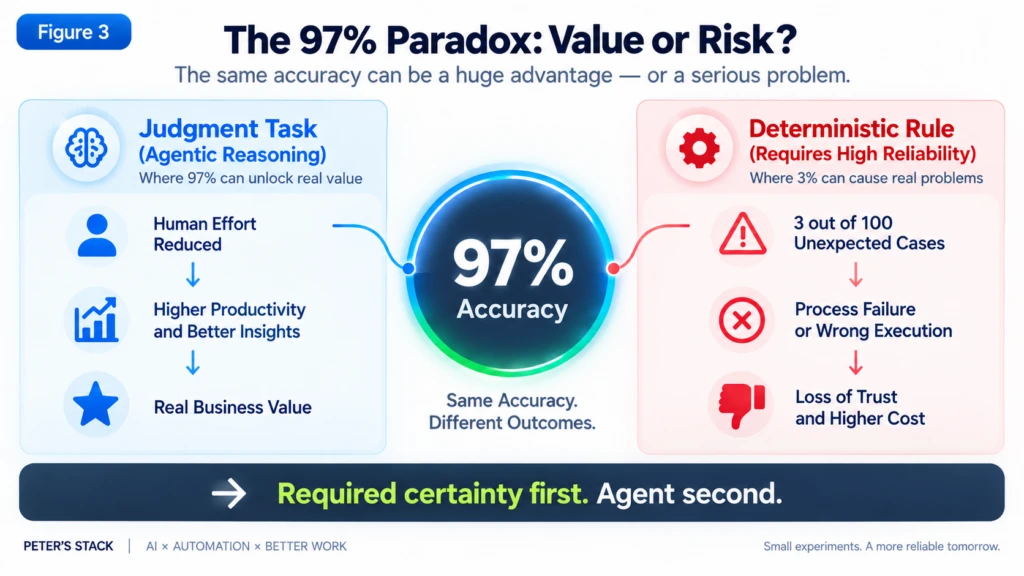
The harder problem in Enterprise AX is not the Accuracy number by itself. It is the level of certainty the business process already expected.
Suppose we are classifying the actual intent behind an inbound customer email. The language may be difficult to reduce to a few rules, and the same sentence may mean something different depending on the customer’s situation. In that kind of problem, 97% accuracy can be highly valuable because a person previously had to read and interpret every message.
Now consider a day-to-day business process where the rule is already explicit.
Valid input A
+ Current state B
+ Business rule C
→ Result D
People using the system experience this as something that “always works that way.” Of course, real software systems can still fail because of infrastructure or operational incidents. When I say 100% here, I do not mean that the entire system can never fail. I mean that given the same valid input and the same state, the business rule is expected to produce the same result.
If that rule is handed to an Agent and only 97 out of 100 cases are handled correctly, a developer may say:
97% is still strong performance, isn’t it?
The customer sees a different problem.
Why did a process that already worked correctly fail three times after AI was added?
That reaction is reasonable. The task may never have been a probabilistic judgment problem.
This is the distinction I care about.
The problem may not be low Agent Accuracy. The problem may be an architecture that inserted a probabilistic system into a place where an Agent was not needed.
Without that distinction, the customer starts questioning the model or the implementation. The designer then responds by making the Prompt longer, adding more exception rules, or upgrading to a larger model. But if the root cause is architectural, a model upgrade does not remove it.
Needing Probabilistic Judgment Is Not the Same as Allowing Probabilistic Execution
In the previous article, I argued that even after connecting Tools through MCP, Tool Planning should be separated from actual Execution Authority. An Agent may decide what should be done, but that does not mean it should also decide whether the Action is allowed to happen in a business system.
This article asks an even earlier question.
Did the decision itself really require LLM reasoning?
Consider a Customer Email flow.
Customer Email
    ↓
Deterministic Intake
Schema / Required Field / Identity / State
    ↓
Agentic Reasoning
Intent Interpretation / Classification
    ↓
Deterministic Control
Routing Rule / Policy / Idempotency
    ↓
Executor
CRM Update / Notification
Interpreting the email’s intent is a good fit for an Agent. But if Intent = Warranty and Region = Korea always route to a designated Queue, there is no reason for the LLM to reinterpret that business rule on every run. Once the rule is explicit, Code is the more appropriate place for it.
The distinction can be summarized in one sentence.
Needing probabilistic judgment and being allowed to execute probabilistically are completely different questions.
Agentic Architecture does not mean making the entire system probabilistic. A better pattern is to place the Agent in the smallest area that genuinely requires interpretation of uncertainty, while keeping the rest deterministic wherever possible. That makes Test, Retry, Audit, Cost, and Latency much easier to manage.
Why I Actively Use n8n for Fast PoCs
This is where n8n enters the picture.
One point needs to be explicit: I am not arguing that an entire Enterprise AX Production environment should be built on n8n. Depending on Availability, Security, IAM, Transaction, State, Deployment, and Observability requirements, components such as AWS Step Functions, Lambda, Queue, API Gateway, an Application Backend, or an Integration Layer may be better choices for the operating environment.
Where I use n8n aggressively is rapid PoC work and Architecture Exploration.
When an idea appears, I can connect the major responsibilities quickly and make the flow actually run.
Trigger
→ Validation
→ API
→ JavaScript / Python
→ LLM / Agent
→ IF / Switch
→ External System
→ Result
This is especially useful when an Agent is involved because the boundary between Agentic and Deterministic behavior becomes visible.
n8n itself now emphasizes this combination. Its AI Agent page describes the platform as “automation engine first” and highlights mixing deterministic automation steps with AI, then adding Human-in-the-loop controls, Error Handling, and Fallback Logic around the Agent.
That direction matches why I use n8n in PoCs.
I used the same principle in an earlier PoC that connected GitHub commits to n8n and an OCI Runtime. AI could decide what should change, but Repository, Branch, Commit SHA, Allowed Path, and Action Allowlist conditions were checked deterministically in n8n Code/IF logic and FastAPI.
The important part was not n8n itself.
Reasoning
→ AI

Policy / Routing
→ Deterministic Logic

Execution
→ Controlled Runtime
The value was being able to test that boundary quickly in a system that actually moved data and executed Actions.
The Real Output of an n8n PoC Is the Blueprint
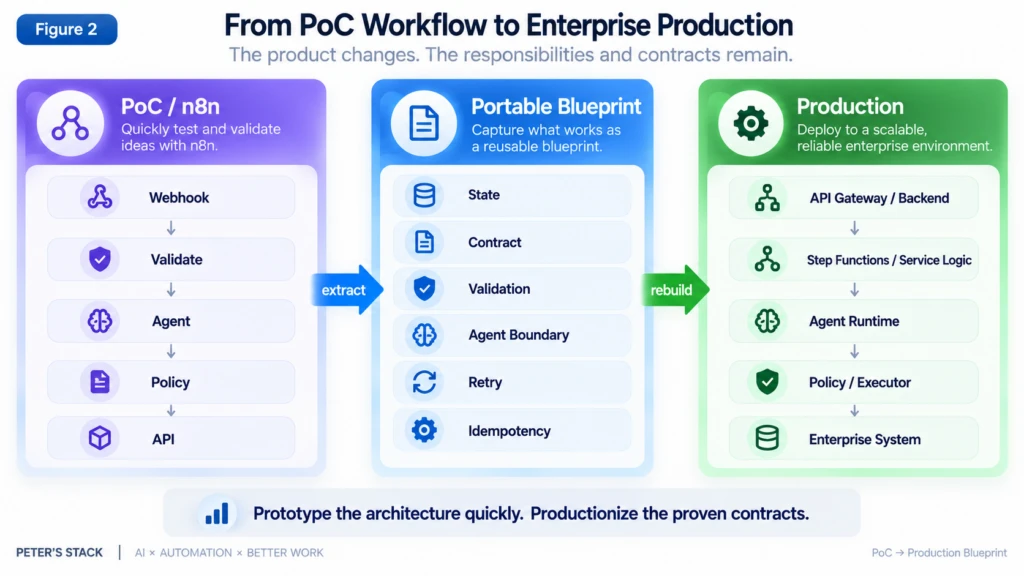
Moving from PoC to Production does not mean copying the n8n Workflow node for node.
Suppose the PoC looks like this.
Webhook
→ Validate Input
→ Lookup Context
→ Agent
→ Parse Result
→ Policy Check
→ CRM API
In an Enterprise environment, those same responsibilities may be redistributed across different implementation components.
- Webhook / Trigger: API Gateway, Event Bus, or Application Backend.
- IF / Switch: Backend Business Logic or State Machine Choice.
- Code Node: Lambda, Container Service, or Backend Module.
- Workflow State: Step Functions, Durable Orchestrator, or Job Store.
- Credential: IAM, Secret Manager, or Workload Identity.
- Retry / Timeout: Step Functions, Queue, or Application Runtime Policy.
- Agent Node: Agent Runtime, Model API, or Managed Agent Service.
- HTTP Request: Enterprise Integration Layer or a typed API client.
AWS describes a related pattern in its guidance for using Step Functions with Lambda, including explicit orchestration for sequential processing, conditional workflows, error handling, and human approval. When it is more appropriate to keep workflow logic inside a standard programming language, a code-first approach such as Lambda Durable Functions can be another option.
The point is not to convert each n8n Node into one Step Functions State.
What needs to be validated in the PoC is the set of responsibilities and contracts.
- Where does State first appear?
- Which inputs must be validated?
- Which conditions are fixed Rules?
- Where is Agent reasoning actually necessary?
- What Schema must the Agent Output satisfy?
- Can a Retry happen without duplicate execution?
- Which Actions require Approval?
- What Payload Contract is sent to the external system?
That is why I think of an n8n Workflow as an Executable Architecture Sketch.
A PowerPoint diagram can describe boxes and arrows, but calling the real APIs and moving real Payloads through the flow exposes problems much faster. The JavaScript or Python written during that work is not necessarily throwaway code either. Validation Logic, Data Transformation, Schema, API Contract, and Payload Shaping often become small blueprints for the Backend Logic that will later live in the target AX system.
Deterministic Problems Become More Painful When You Give Them to an Agent
An architecture that delegates everything to an Agent can look very simple at first.
A Prompt such as “Understand the customer’s request, choose the appropriate Tool, and perform the necessary work” may produce an impressive PoC with only a few lines of instruction.
Then the design starts absorbing real Business Requirements and the customer’s Existing Process.
If A, use Tool 1.
But do not execute when Status is B.
Only Role C may make this change.
If D is missing, retrieve it first.
If this request was already processed, do not execute it again.
Retry twice after failure.
After the second failure, leave the request in a Queue.
If the amount is above a threshold, require Approval.
As those conditions accumulate, the Prompt and Agent Harness begin to resemble a Workflow Engine and Policy Engine.
Giving a deterministic problem to an Agent does not remove complexity. It moves the complexity into the Prompt and Harness.
Rules hidden there are harder to test than ordinary Code, harder to explain as an execution path, more expensive in tokens, and more exposed to behavior changes after a model update.
This matters especially because customer processes already interlock across systems like gears. Salesforce Record State, ERP processing status, approval permissions, existing Batch jobs, and API call order contain many things that are already “decided.” Making the Agent smarter does not automatically improve those areas.
A clearer architecture can actually reduce the Context the Agent has to process.
Agent
= Interpret / Compare / Infer / Plan / Choose

Deterministic Layer
= Validate / Route / State / Retry / Policy / Persist
Reasoning tokens are better spent where reasoning is genuinely required.
From PoC to Production, the Definition of Value Changes
In a rapid PoC, the key question is relatively simple.
Can it do this?
If I can turn a capability that the customer only imagined into a real screen and Workflow, get feedback within days, and change it again quickly, that is already significant value. This is why I care about reducing Feedback Latency with tools such as an Agent Runtime and n8n.
As the solution moves toward Production, the customer’s question changes.
Can we depend on it?
At that point, Capability alone is not enough.
- Does the same input and state produce a predictable result?
- Can failures be detected and their causes inspected?
- Can the system Retry without duplicate processing?
- Can we trace who made which decision and which Action was executed?
- Does the flow align precisely with the State of the existing Business Process?
- If the Agent is wrong, does the overall system remain in a safe state?
A customer needs answers to these questions before AI becomes part of day-to-day operations rather than a Demo.
That is why I see Reliability not only as a technical Non-functional Requirement, but as part of the Business Value the customer actually experiences.
For a task that requires judgment, 97% AI performance may remove a large amount of manual work. For a task that was already expected to execute deterministically, reducing it to 97% because AI was introduced turns the same number into an Operational Failure.
How Far Should the Agent Be Allowed to Go?
When I look at each step in a business process now, I start with four questions.
- Can the outcome be expressed as a clear rule? If yes, I treat Code or a Workflow as the first candidate. Allowlist checks, Required Fields, Role Checks, State Transitions, and Routing Rules do not need to be re-decided by an LLM every time.
- Is the same result expected for the same input and state? If yes, the case for keeping it deterministic becomes stronger, especially for Retry, Idempotency, Permission, and Persistence.
- Does the step require interpreting natural language, context, or meaning? This is where the Agent becomes stronger. Reading the customer’s real Intent, comparing multiple pieces of Evidence, deciding what information is missing, or planning the next step is difficult to express as fixed rules.
- Would a wrong judgment create a significant Side Effect? If yes, separate judgment from execution. The Agent may propose an Action, but Authorization, Policy, Approval, and Idempotency should be validated before a Controlled Executor changes the real system.
A compact responsibility model looks like this.
- Interpretation / Classification / Planning: Agent.
- Validation / Routing / Retry / State: Workflow / Application.
- Identity / Authorization / Business Policy: Application / Runtime.
- Side Effect: Controlled Executor.
The point is not to memorize that model by product name. The technology stack will vary by system. It may use n8n, Step Functions, Java/Spring, or a Node.js Backend.
Classify the nature of the responsibility first, then choose the implementation technology.
Workflows Do Not Disappear in the Agent Era
As reasoning models improve and Agent Harnesses become more capable, it is easy to assume that Workflows will eventually disappear.
My experience points in the opposite direction.
As Agents become able to do more, deciding what not to delegate to the Agent becomes more important.
Uncertainty
→ Agentic Reasoning

Certainty
→ Deterministic Control
A deterministic layer does not suppress Agent autonomy. A clear Boundary can give the Agent more freedom where it is actually useful. The Agent does not need to spend tokens repeatedly choosing obvious Tools or re-evaluating fixed Policy. It also does not need to recover every execution failure through more reasoning.
The same principle applies to PoCs. I connect systems quickly with n8n not because I want n8n to become the final answer for Enterprise Production, but because it helps me discover which steps are Reasoning, which are Contracts, and which Rules should eventually harden into Code in Production.
When I first started experimenting with Agents, my question was:
How much can I delegate to the Agent?
Now I ask a different question first:
Does this step really need the Agent to make a judgment?
A good Enterprise Agent Architecture is not defined by how much work it delegates to an Agent. What matters more is how precisely it separates probabilistic judgment from behavior that needs to remain predictable, and how consistently that boundary survives the transition from a fast PoC into the Production Architecture.