
In the previous article, I described a way to maintain market intelligence, customer patterns, competitor changes, and company capabilities as a continuously linted Enterprise Wiki and expose the relevant part as a Canonical Market Lens Skill.
Once that Lens exists, a different question appears.
Should we search the words written in the RFP, or search for what the RFP gives us reason to question about our current strategy?
The second question is much closer to the role I want Enterprise Web Search to play.
A new RFP can contain dozens of technical and operational terms: AI, cloud, networks, security, robots, WCS, PLCs, monitoring, APIs. If an agent simply expands those terms into search queries, it can quickly produce another broad market-research report.
But in most live deals, the problem is no longer to explain everything that exists in the market.
If the company already has a market view, the more useful question is what has changed enough to challenge that view.
Do not turn an RFP into a list of search queries
Consider a sanitized example that we can follow through the article.
A large retailer issues an RFP for a new fulfillment-center automation project. The document emphasizes high throughput, low reject and mis-sort rates, WCS and PLC integration, commissioning, UAT, monitoring, downtime visibility, shorter delivery, price pressure, and OEM dependencies. It also mentions areas such as AI, cloud, and robotics.
Those requirements do not all mean the same thing.
Requirement ≠ Mention ≠ Integration Dependency ≠ Scope Ownership ≠ Strategic Signal ≠ Research Question
A mandatory security requirement does not automatically create a standalone security market-intelligence scope. A cloud reference in a future-readiness section does not necessarily justify opening a new cloud competitor landscape.
By contrast, commissioning, UAT, stabilization, and downtime visibility can become strategic signals because they connect directly to evaluation criteria and operational risk.
So the first transformation should happen before Web Search:
Raw RFP → Document Authority / Role → MI Relevance Gate → Strategic Signal → Deal MI Context
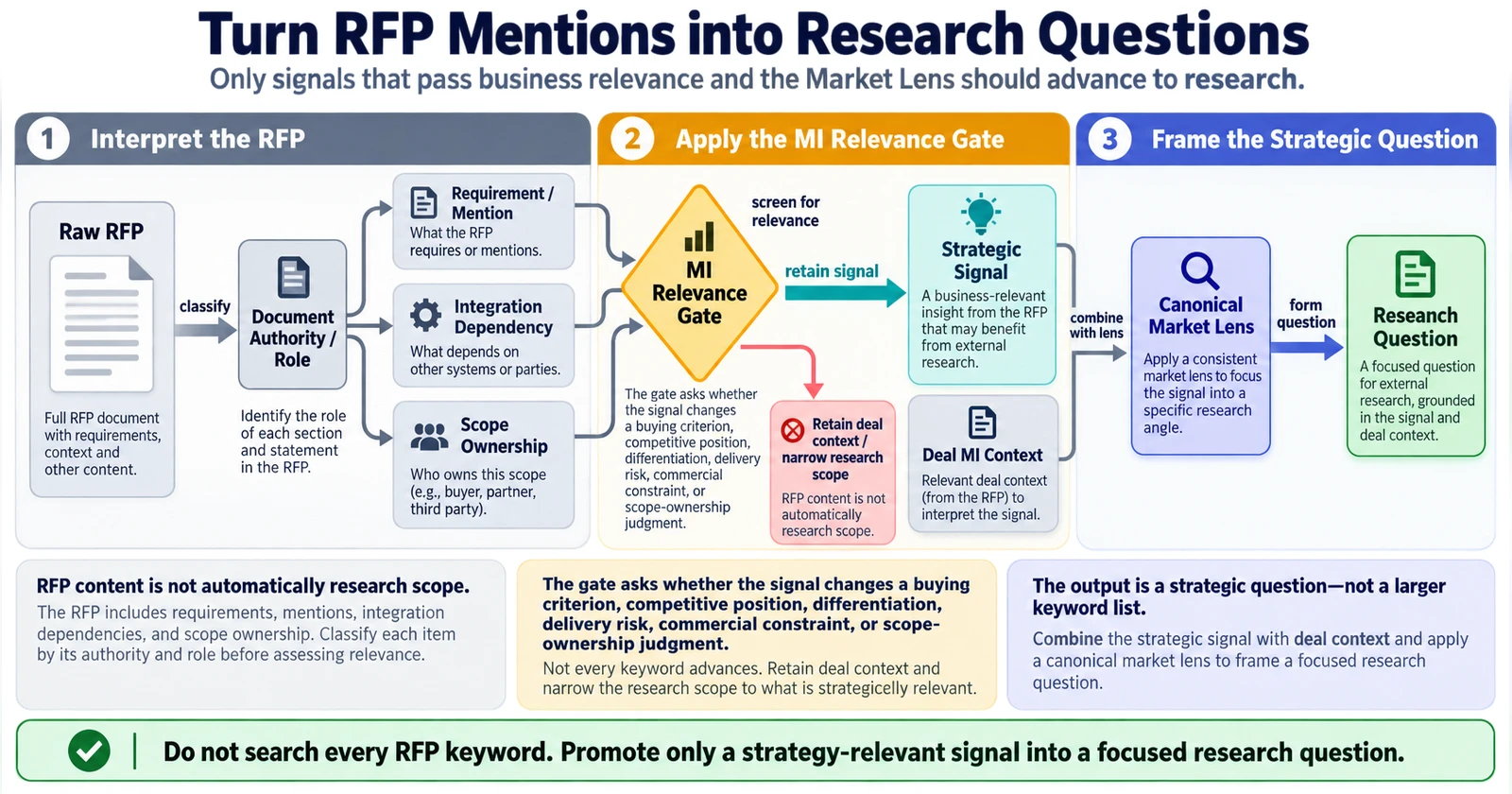
The goal is not to create a perfect summary of the RFP. It is to retain the signals that justify external research.
A signal becomes useful only when it meets the Lens
A Strategic Signal is still not enough to start searching.
Suppose the RFP requires an aggressive commissioning schedule and strong UAT performance validation.
Taken alone, that might lead to a generic search for commissioning trends. Now assume the Market Lens already contains several pieces of enterprise knowledge:
- Operational reliability and ramp-up risk are meaningful customer buying criteria.
- Competition is not limited to peak equipment performance; integration and operational certainty also matter.
- The company has repeatedly demonstrated strength in integration and commissioning.
- Competitors expanding software control and lifecycle capabilities could narrow that differentiation.
The RFP signal now becomes a Strategic Tension against the existing Lens.
Deal Signal × Canonical Market Lens → Strategic Tension → Research Question / Hypothesis
A working hypothesis might be:
For this deal, the ability to prove fast and stable ramp-up may be a more material differentiator than peak throughput alone.
The important point is that this is not a conclusion.
A hypothesis is not a fact.
A useful Web Search Agent should not elaborate the hypothesis into a persuasive narrative. It should search for evidence that could prove it wrong as well as evidence that could support it.
Define the evidence requirement before the search query
A conventional Web Search flow often jumps from the question directly to query generation.
It can produce searches such as “warehouse automation trends,” “AI logistics,” or “robotics market” very quickly.
That is useful for information gathering, but something is missing if the objective is strategy validation.
The sequence I find more useful is:
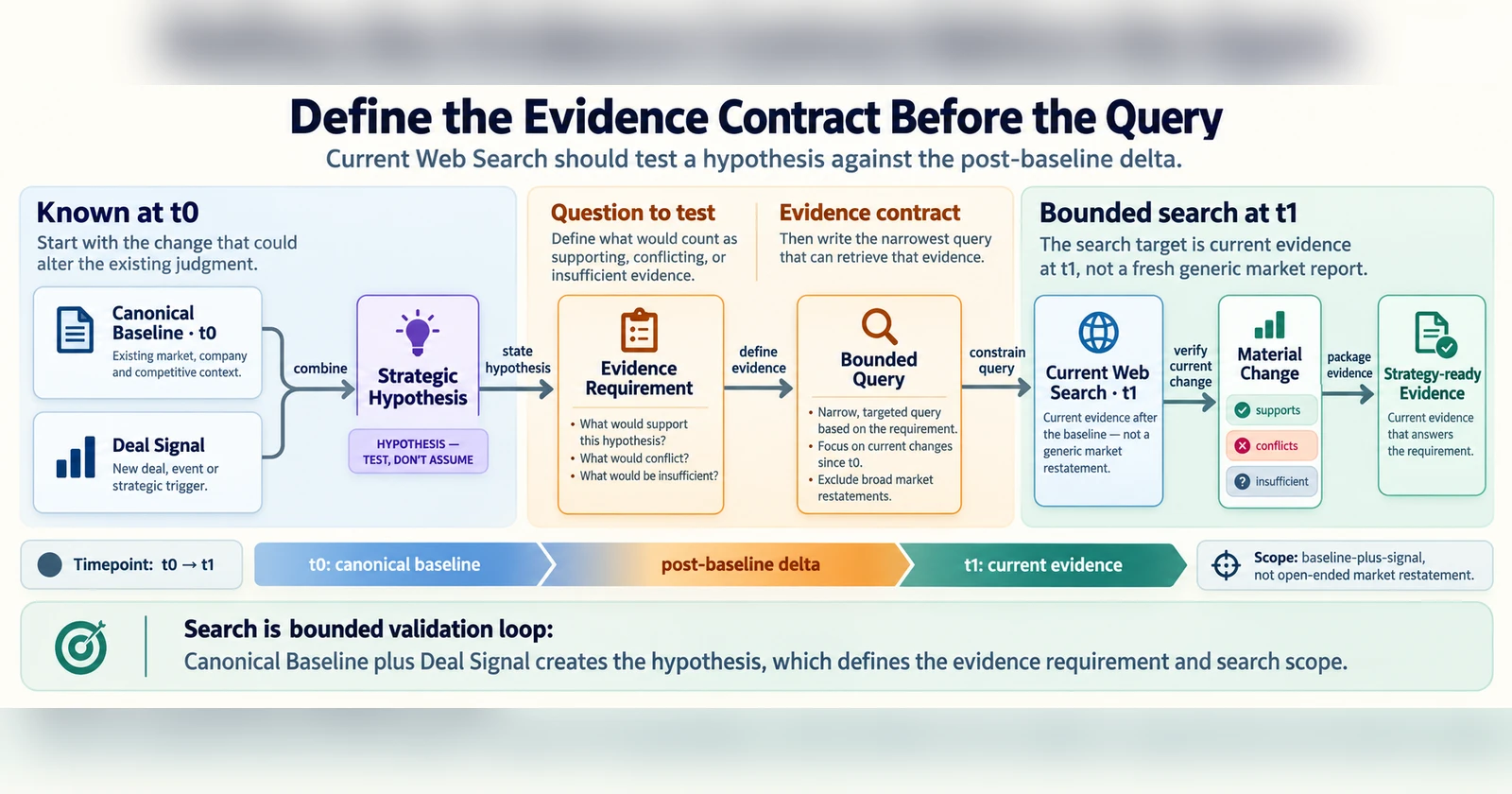
RFP → Strategic Signal → Hypothesis → Evidence Requirement → Query → Search
Before generating queries, define what evidence would actually change the state of the hypothesis.
For example:
- Are competitors using recent large references to demonstrate shorter commissioning or more stable ramp-up?
- Do recent customer references or procurement signals place more weight on UAT, recovery, and downtime visibility?
- Has a competitor moved beyond equipment supply into proven WCS, control integration, or lifecycle operations?
- Does public delivery evidence demonstrate real lead-time capability, or only a roadmap and marketing claim?
- Are operational KPIs available, or only qualitative statements?
This changes the role of query generation.
An Evidence Contract should come before Query Expansion.
Once the proof requirement is clear, the search can become much narrower.
Do not research a market you already know from zero
In Part 1, I described the Canonical Market Lens as a time-bounded baseline.
That gives Part 2 a clear temporal structure:
Canonical Baseline at t0 + Deal-specific Signal → Strategic Question → Current Web Evidence at t1
The agent should not ask, “What are the current trends in warehouse automation?”
It can ask much more specific questions:
- Has competitor A expanded from equipment-centric capability into proven WCS and robot orchestration?
- Has competitor B demonstrated autonomous recovery or optimization in a real deployment?
- Are recent large logistics projects placing greater weight on observability and lifecycle operations?
- Is delivery lead time becoming material enough to affect procurement decisions alongside technical differentiation?
All of these questions concern the same market. But the purpose is different.
This is not market explanation. It is a stress test of the current strategy.
Evaluate search results by materiality, not relevance alone
A relevant search result is not automatically important to the deal.
Semantic relevance and strategic materiality are different questions.
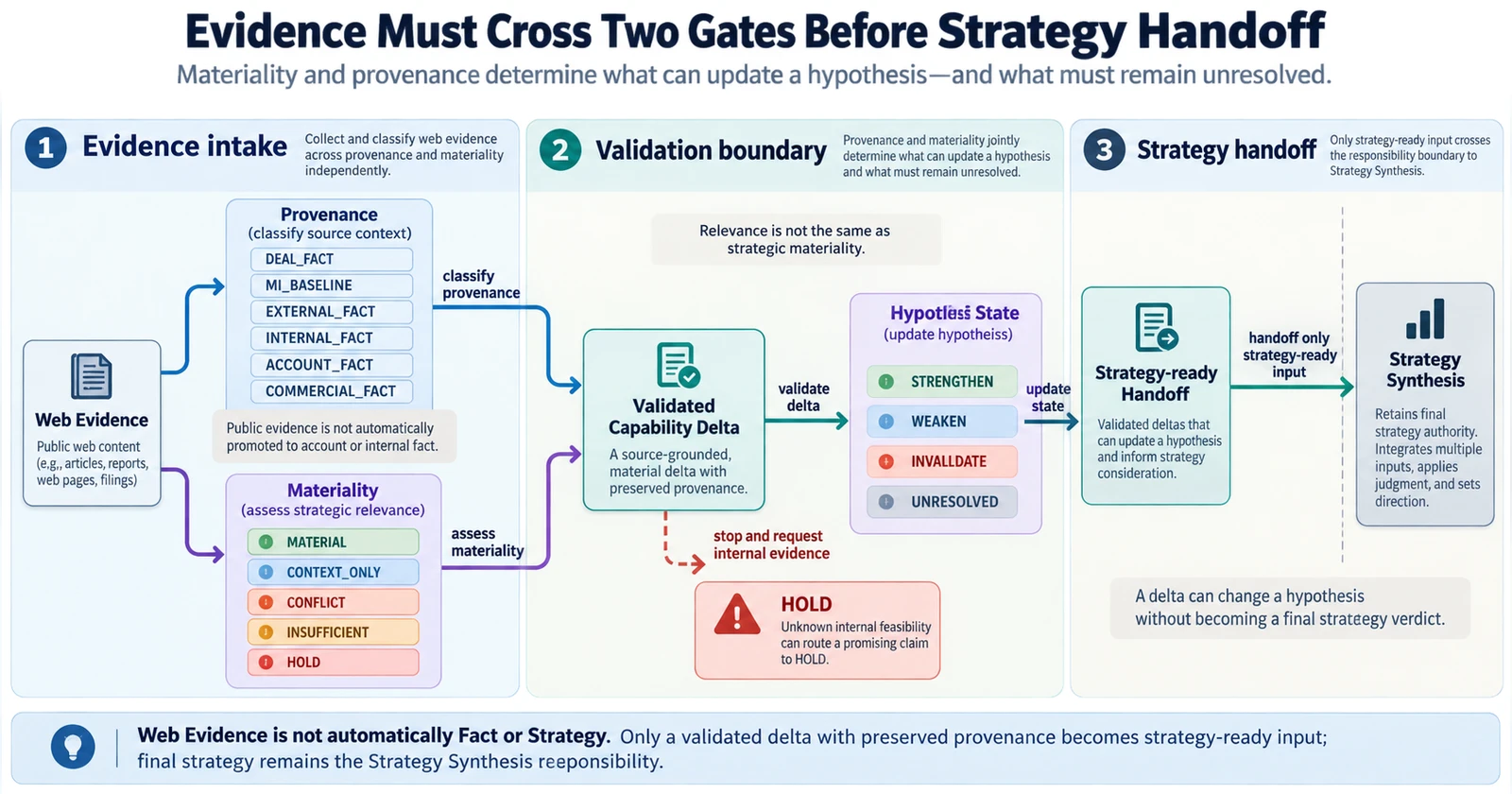
I find it useful to classify evidence into a few explicit states:
- MATERIAL — important enough to change the current strategic hypothesis.
- CONTEXT_ONLY — relevant to the topic, but with limited impact on this deal.
- CONFLICT — contradicts the current Canon.
- INSUFFICIENT — not strong enough to support the claim.
- HOLD — material, but cannot be promoted because required internal, delivery, or commercial evidence is missing.
A simple materiality test is to ask whether the evidence changes any of the following:
- Customer Buying Criteria
- Competitor Position
- Our Differentiation
- Delivery Risk
- Commercial Constraint
- Scope Ownership
If the answer is no across all of them, even a very recent article may be CONTEXT_ONLY for the current deal.
Conversely, a narrow competitor reference can be MATERIAL if it directly challenges a differentiation that the strategy currently depends on.
From a search result to a Strategy Delta
Assume the Canon contains this baseline:
Competitor A is strong in robotics, but there is limited evidence of large-scale integrated WCS and control capability.
Current Web Research then finds a recent large deployment reference, evidence of WCS integration, and an expanded robot-orchestration roadmap.
The agent should not jump to:
“Competitor A is now stronger than us.”
That would move directly from evidence to a strategy verdict.
A safer chain is:
Baseline → New Evidence → Validated Capability Delta → Deal-specific Strategic Impact
The Delta might instead be expressed as:
Our existing integration differentiation may be narrowing on some competitive dimensions.
The state of the hypothesis can then be updated explicitly:
- STRENGTHEN
- WEAKEN
- INVALIDATE
- UNRESOLVED
The value of the Web Search Agent is not that it accumulated more information.
It is that it identified which existing assumptions need to be reopened.
Public evidence is not an internal fact
In Enterprise Research, provenance matters as much as content.
Suppose public evidence suggests that a customer is strengthening internal technology ownership.
That does not justify the conclusion:
“The customer builds all automation capabilities internally.”
The distinctions matter:
strong internal technology ownership ≠ all automation capability built internally
public investment signal ≠ current procurement boundary
competitor product announcement ≠ proven production capability
Evidence therefore needs provenance classes such as:
- DEAL_FACT
- MI_BASELINE
- EXTERNAL_FACT
- INTERNAL_FACT
- ACCOUNT_FACT
- COMMERCIAL_FACT
- STRATEGIC_HYPOTHESIS
And some promotions should simply be prohibited.
Public inference → ACCOUNT_FACT is invalid.
Hypothesis → FACT is invalid.
A position in an older report should not silently become a current installed-base fact.
Without these boundaries, a Search Agent can turn from a research tool into a certainty generator.
External MI should produce strategy-ready intelligence, not final strategy
There is one more boundary to keep.
Even excellent external research is not enough to decide the final strategy.
Strategy depends on information that the public web cannot provide reliably:
- Company Capability
- Account / Relationship
- Historical Win / Loss
- Delivery Reality
- Commercial Constraint
So the output boundary is better expressed as:
Deal Context + Canonical Lens + Current External Evidence → Validated Delta → Strategy-ready Hypotheses → Strategy Synthesis
External MI alone is informative.
It becomes strategy-relevant when it is combined with Deal Context and Internal Reality.
This is an important architectural distinction.
If the Web Search Agent starts producing final Win Themes, it will be tempted to fill gaps in internal knowledge simply to complete the narrative.
Those decisions belong in a higher Strategy Synthesis layer.
A useful agent must be able to HOLD
Delivery is a practical example.
Suppose Web Research finds strong evidence that faster delivery is becoming a material competitive factor in recent deals.
The Market Lens also says that delivery assurance fits the current competitive axis.
It becomes tempting to turn “Fast Delivery” into a strategy message.
But if internal manufacturing slots or critical-component capacity have not been confirmed, the state should be different.
External Evidence = STRONG
Strategic Relevance = HIGH
Internal Feasibility = UNKNOWN
The correct result is HOLD.
That matters because:
A good agent is not the one that produces the most compelling stories. It is the one that can stop a story that the evidence does not yet allow.
HOLD is not a failure state. It preserves the evidence boundary.
The next action may not be another Web Search at all. It may be an internal Evidence Request.
Scope, Lens, Delta
The three articles now form one sequence.
The first problem was Scope.
What is eligible to be searched?
The second was Lens.
How does the company interpret that market?
The third is Delta.
What has changed enough to challenge the current strategy?
Once these responsibilities are separated, Web Search behaves differently.
Instead of sending every RFP keyword to the internet and collecting as much as possible, the agent can identify the strategic tension created by the deal, compare it against the Canonical Lens, and search only for the evidence needed to test that tension.
That is why the performance of an Enterprise Web Search Agent cannot be judged only by the volume or freshness of its search results.
A more useful question is:
Did the agent narrow down exactly what the company needs to revalidate about its current strategy?
At that point, Web Search stops being only a market-research tool.
It becomes part of strategy validation.