
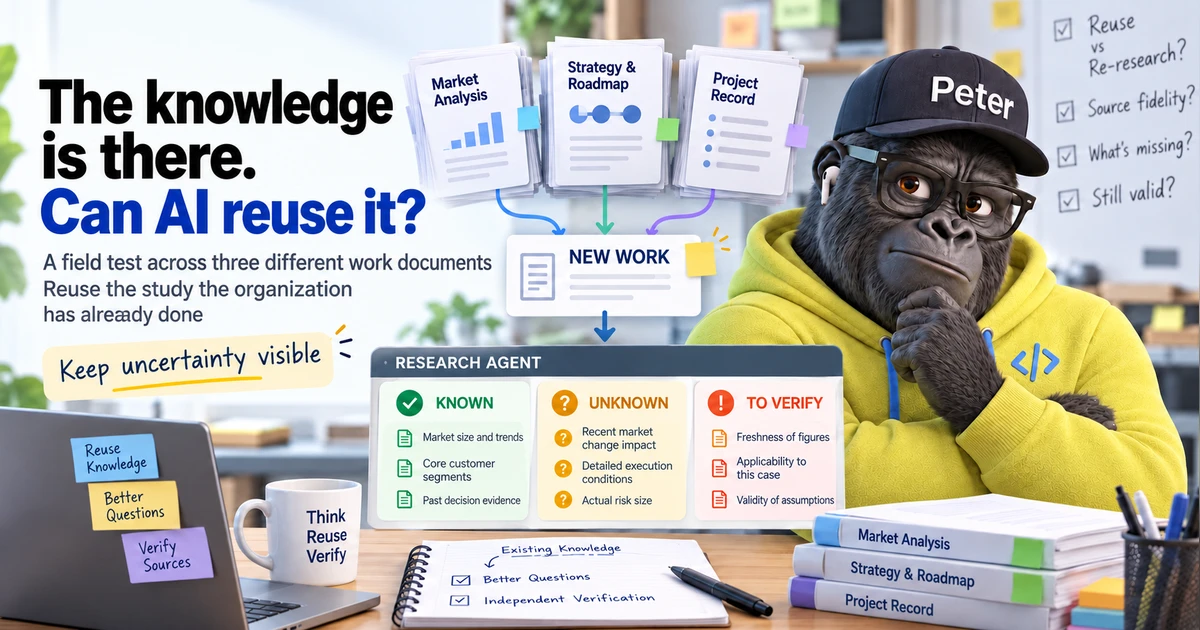
When enterprises discuss applying AI, the conversation often begins with acquiring more data. Sometimes that is exactly what is missing. But anyone who has worked inside a large organization knows there is often more knowledge on hand than we first assume: industry reports, business plans, technology roadmaps, and the records left by previous projects.
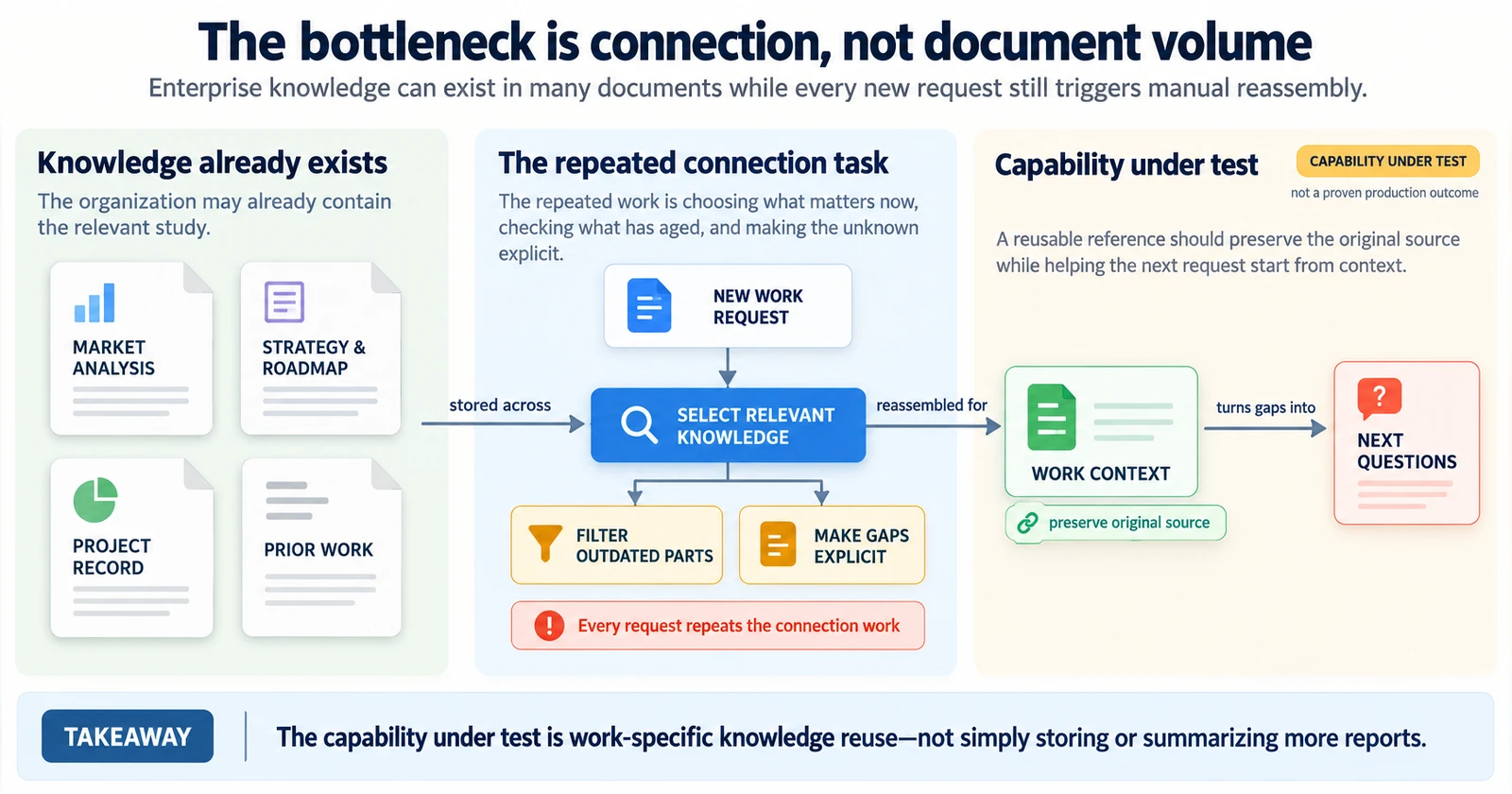
A new request arrives, and someone has to find those documents again, decide which parts matter, discard outdated assumptions, and connect the pieces. It is a familiar part of enterprise work. Adding an AI assistant does not automatically remove it.
I have been experimenting with a knowledge-based AI workflow to answer a narrower question: Can we make the work an organization has already done useful to the next piece of work, without researching everything from scratch?
The documents exist. Reconnecting them is the repetitive part.
An industry report may describe the market, but it rarely tells you exactly what your own team can deliver. A technical portfolio may describe capabilities but not the lessons of a past engagement. Public information can reveal what has changed since either document was written. Naturally, the quality and freshness of these assets varies between organizations.
People bring these sources together through experience. They choose relevant material, challenge old claims, and turn missing information into questions. Calling this merely “document search” understates the judgment involved.
I was not trying to build a report summarizer.
It is relatively easy to hand a model a market report and ask for a summary. It is much harder to determine which of the report’s assumptions apply to a specific new request. General knowledge about a market is not the same as knowledge relevant to a particular task.
So the experiment began with preserving source material and its provenance, converting selected enterprise knowledge into reusable context, and matching that context against a new work document. The baseline was never intended to be an eternal truth. It represents what was known at a particular point in time, and newer evidence may challenge it.
I have previously written about accumulating an enterprise market lens and turning work context into more focused research questions. This time the interesting part was what actually happened when I tried the approach on different documents.
Three documents with very different demands
The specific customers, projects, and source materials are not relevant to the public lesson, so I will describe the documents only by their characteristics.
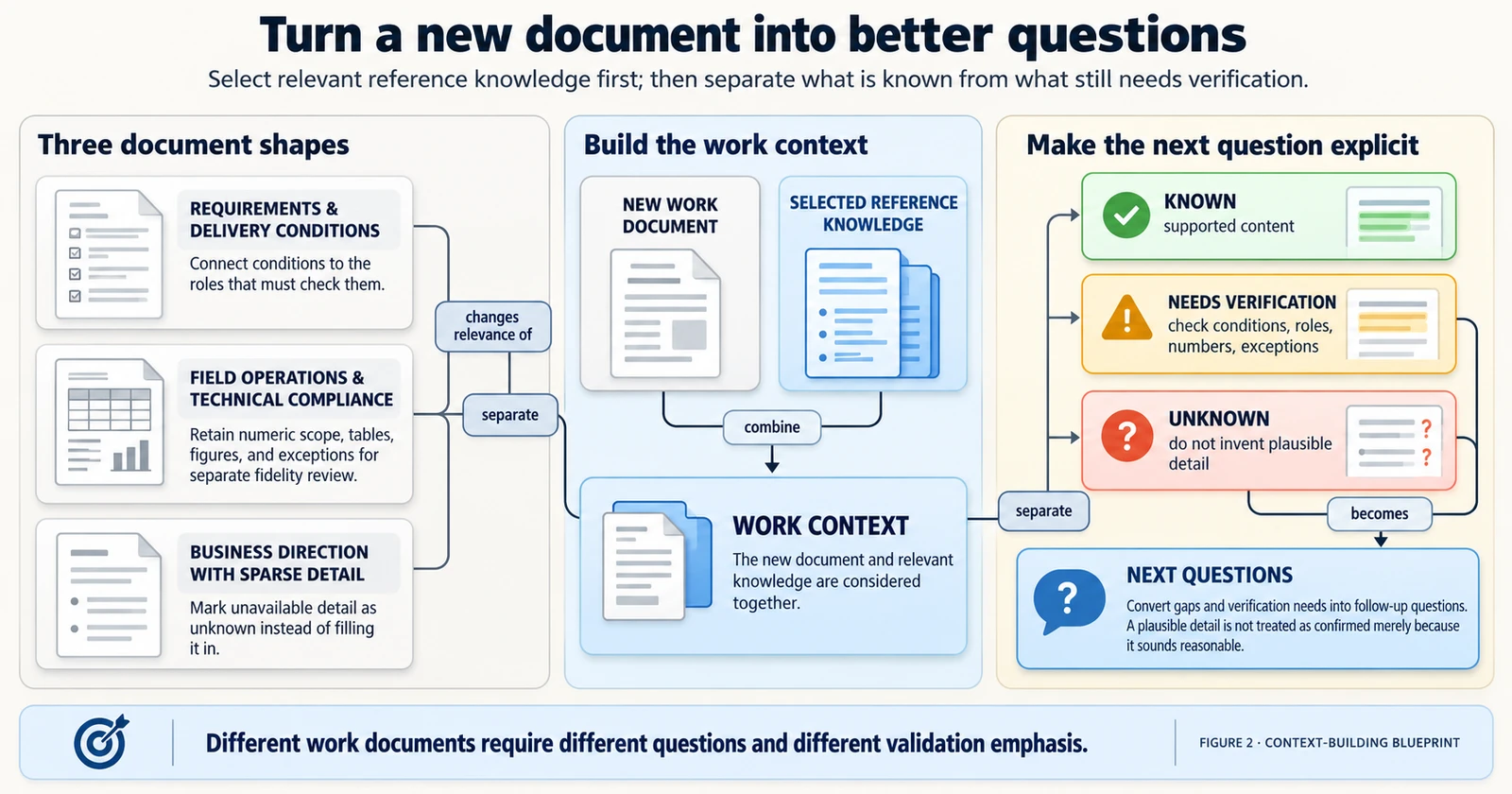
The first document combined detailed requirements with multiple delivery constraints. Summarizing the technical vocabulary would have missed the point. What mattered was the relationship between conditions and the questions that needed to be answered. The AI selected relevant baseline knowledge and began proposing further questions about roles, responsibilities, and unverified conditions.
The second focused on operational and technical compliance conditions. Clear prose was not enough. Some relationships embedded in tables and images were lost during processing, while the force of certain numbers and conditions was not fully preserved in the resulting material. The file had been processed, but fidelity to the original still needed checking.
The third stated objectives and a general direction without all the detailed conditions. In that situation, confidently filling in missing details would be a failure. The system needed to separate established facts from information that had not been supplied or could not be verified. Even when external research executed successfully, some important questions remained unresolved.
I was not looking for one answer that fit all three. I wanted to see whether the choice of existing knowledge and the next research questions would change with the work itself.
The evolution of the questions was more interesting than the answers.
During the trials, the AI sometimes proposed lines of inquiry that were not explicit in the initial request. A new finding could raise a question about who performed a particular role or whether an assumption still held. That is different from producing a longer list of related search queries.
But an interesting result in one run is not proof of reliable performance. When comparable work was repeated independently in a fresh session, meaningful exploration reappeared, yet some relationships found in the earlier run were missed. Insight in one run and repeatable quality are different outcomes.
There was another useful reminder: a search service can execute successfully and return citations without resolving the business question. Finding a relevant article, establishing a specific fact, and deciding whether that fact matters to the current work are separate steps.
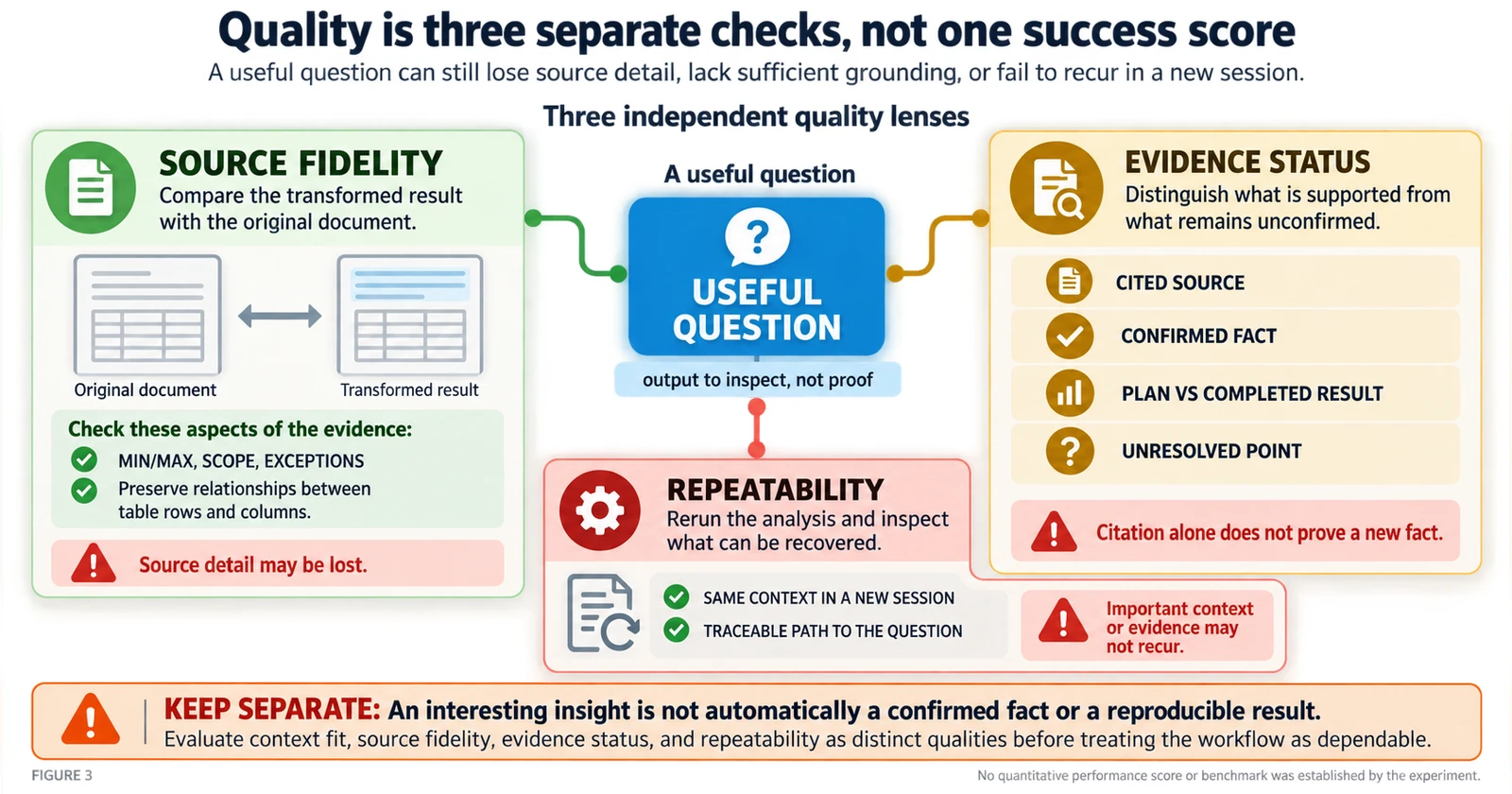
Three quality problems became hard to ignore.
Source fidelity came first. Minimum and maximum requirements, exceptions, the scope of an obligation, and relationships inside tables can be weakened when a document is transformed into readable prose. Those details must be checked against the original.
The status of evidence came next. An announced plan is not an implemented outcome. Information from last year is not necessarily valid today. When a fact cannot be established, “not verified” is a useful result rather than an embarrassment.
Repeatability was the third issue. Producing a good question once does not make a dependable enterprise system. We should know which context and evidence supported it, and whether the important relationships survive an independent attempt.
Enterprise knowledge can become a starting point, not simply a larger search box.
Collecting more documents is not sufficient. A system needs to choose which knowledge belongs in the current task, preserve the original sources and versions, and resist turning every new web finding into accepted institutional knowledge.
Most importantly, it must distinguish what the organization already knew, what fresh evidence actually established, and what remains unknown. High-consequence decisions still require an accountable human owner.
I have not proved a measurable reduction in effort or an increase in business outcomes from these experiments. What I have seen is a promising change in how the problem can be approached, along with limitations that remain very real.
The goal is not to claim that an AI has become a better market analyst than the people doing the work. It is to see whether an organization can reuse what it has already learned and ask better questions about what it still does not know. Perhaps the more valuable AI is not the one that finds the most information, but the one that connects existing knowledge to the next decision more carefully.