Skip to content
Peter's Stack
  • Home
  • About
  • Topics
  • Privacy
  • Contact
  • 한국어

When Web Search Becomes Strategy Validation: Using a Market Lens to Pinpoint Research from an RFP
October 4, 2026 by Peter
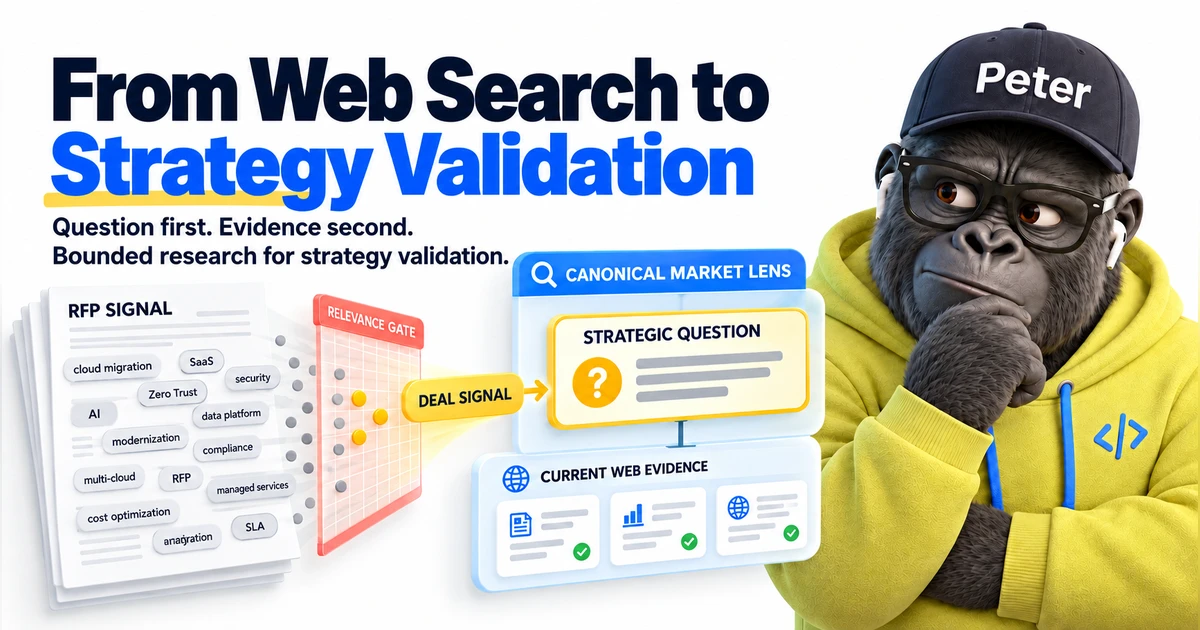
An RFP SIGNAL document with varied technical terms narrows through a RELEVANCE GATE and DEAL SIGNAL into a CANONICAL MARKET LENS containing a STRATEGIC QUESTION and CURRENT WEB EVIDENCE, while Peter observes on the right.

Instead of expanding RFP keywords into broad searches, combine Deal Signals with a Canonical Market Lens, define the evidence required, and use Web Search to validate strategy-relevant deltas.
Categories Enterprise AI Tags Context Engineering, Enterprise AI, Market Intelligence, RFP, Web Search Agent

Teaching a Web Search Agent How Your Company Sees the Market: Canonical Market Lens and the LLM Wiki

October 4, 2026 by Peter
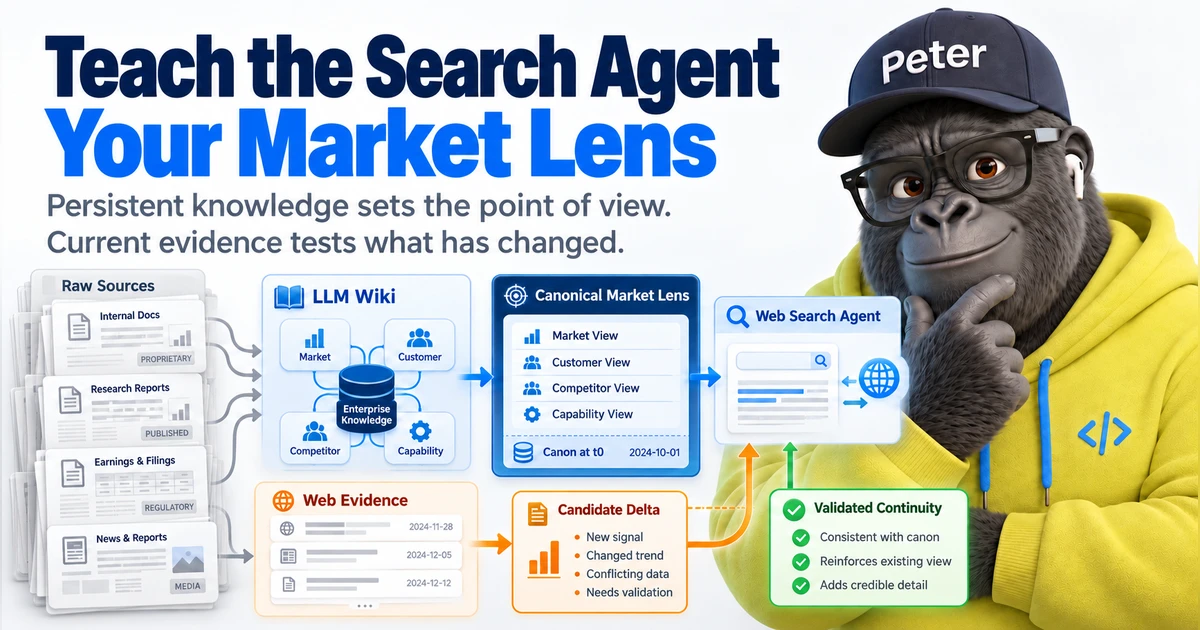
A layered architecture shows enterprise documents and research flowing into an LLM Wiki, then a Canonical Market Lens and Web Search Agent. A separate Web Evidence stream enters a Candidate Delta and validated continuity path, with the Peter gorilla character on the right.

Instead of re-injecting market reports, competitor research, and company capabilities into every prompt, maintain them in an LLM Wiki and compile a reusable Canonical Market Lens for enterprise Web Search.

Categories Enterprise AI Tags Context Engineering, Enterprise AI, LLM Wiki, Market Intelligence, Web Search Agent

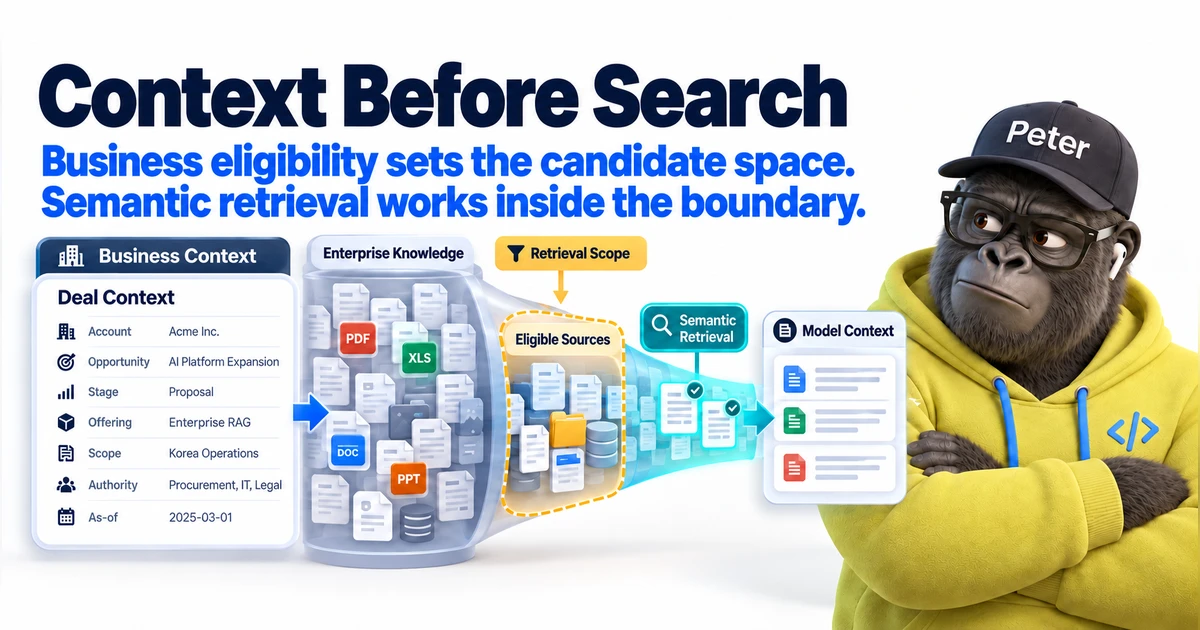
Enterprise RAG Should Not Start with Search: Narrow the Retrieval Space with Deal Context First

October 4, 2026 by Peter
A Deal Context card narrows an Enterprise Knowledge document store through Retrieval Scope and Eligible Sources, then passes selected material through Semantic Retrieval into Model Context, with Peter beside the funnel.

Enterprise RAG needs a business-valid retrieval scope before semantic ranking begins. This article explains how Deal Context and a Retrieval Scope Contract can constrain the candidate corpus before embeddings and rerankers do their work.

Categories Enterprise AI Tags Context Engineering, Deal Intelligence, Enterprise AI, Enterprise RAG, Retrieval

Codex Built It. Antigravity Reviewed It — Coding Agents Need Role Separation Too

October 3, 2026 by Peter
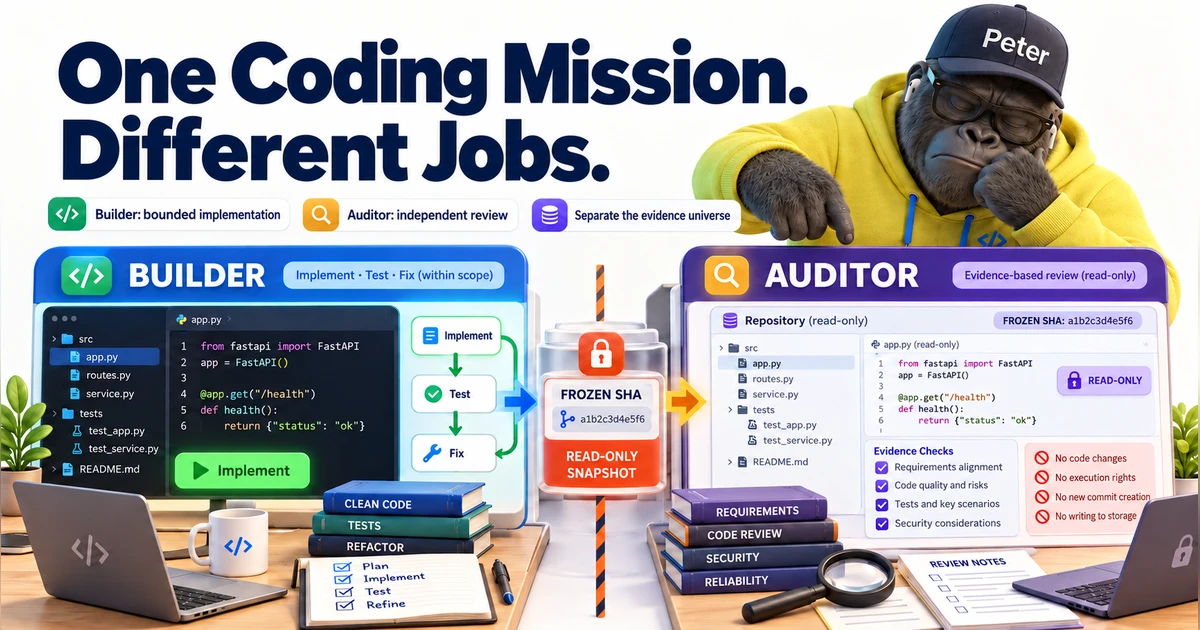
A split workbench shows a Builder handling implementation, tests, and fixes on the left, while an Auditor reviews a FROZEN SHA in a read-only repository on the right.

A practical multi-model coding pattern: split one implementation mission into Builder, Investigator, Auditor, and Verifier roles, then spend expensive reasoning only where it adds value.

Categories Enterprise AI Tags AI Coding, Antigravity, Codex, Model Routing, Multi-Model

JEV and GPT-6 Luna Agreed on All 17. So Why Did the Designs Differ?

October 3, 2026 by Peter
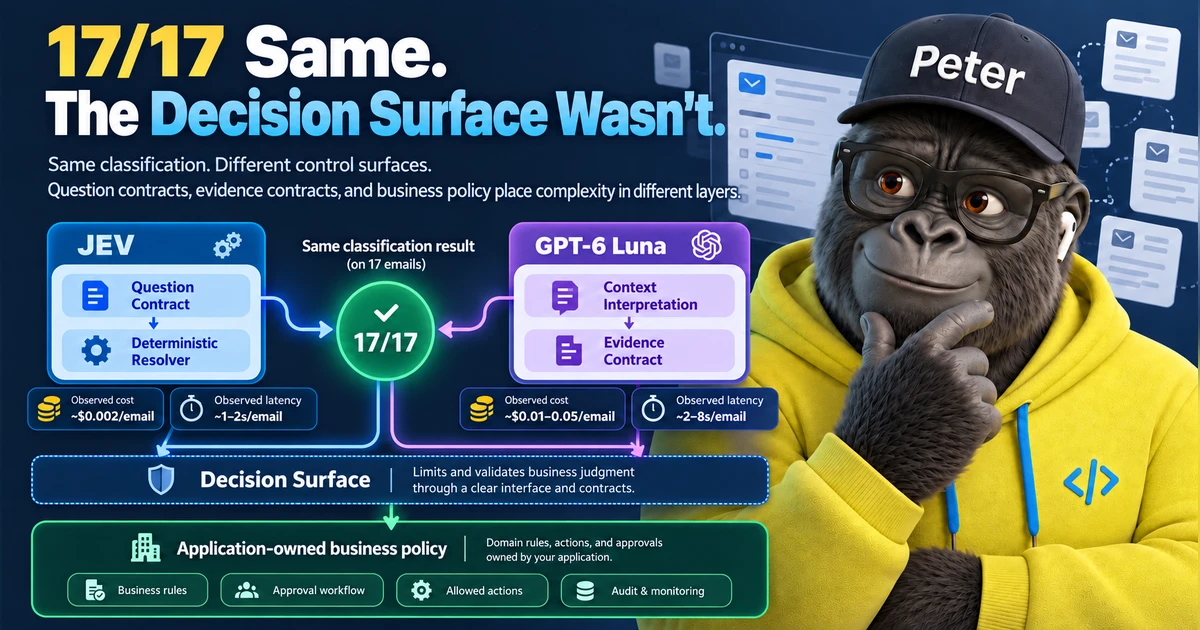
Featured illustration showing JEV and GPT-6 Luna reaching the same 17/17 email classification result while following different decision surfaces and control paths.

JEV and GPT-6 Luna produced the same final classification across 17 Email-to-Case samples. The real difference appeared in cost, evaluation, Question Contracts, Evidence Contracts, and where business authority remained.

Categories Enterprise AI Tags AI Classification, GPT-6 Luna, JEV, OpenAI Decisions API, Salesforce
Older posts
Newer posts
← Previous Page1 Page2 Page3 Page4 … Page6 Next →

Recent Posts

  • The AI Code Review Bottleneck: Why Does Faster Code Generation Create More Work?
  • Why Did the Same Decision API Produce Different Answers? Question Engineering with Microsoft Decision-1 and JEV
  • How Should Enterprises Calculate AI ROI? Measure Cost per Accepted Business Outcome, Not Token Spend
  • Why Can Agent Skills Reduce Performance? Lessons from Microsoft Research and Enterprise AI
  • Agent Skills vs MCP: How SKILL.md Changes the Way AI Agents Work
© 2026 Peter's Stack · About · Contact · Privacy Policy