
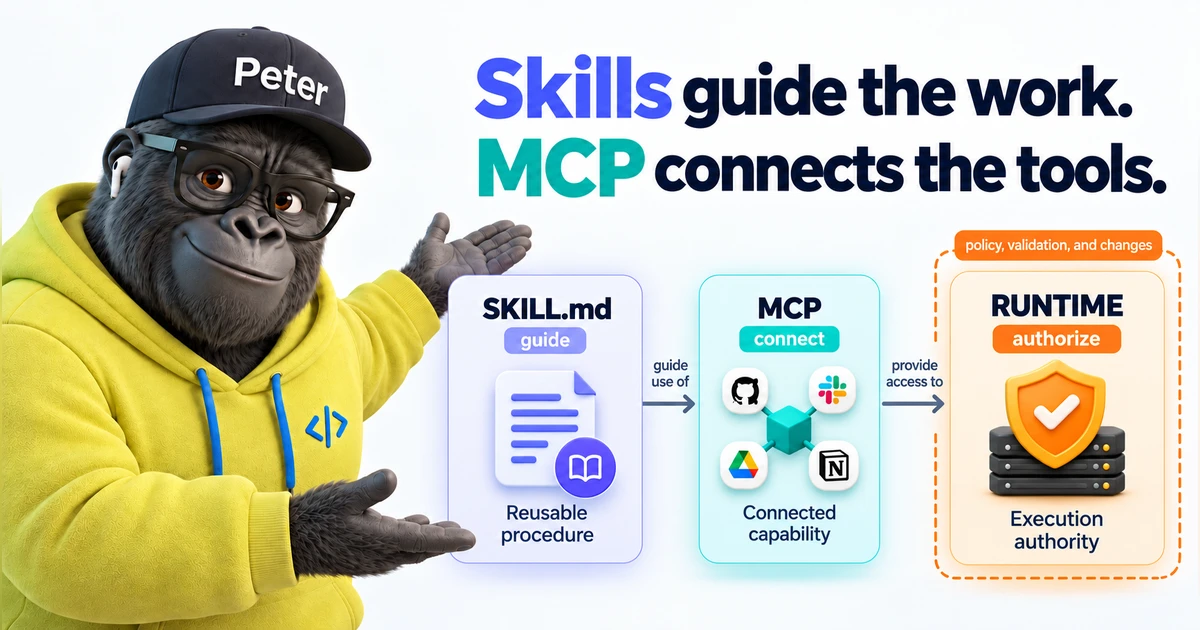
Imagine giving an agent access to product specifications, an account lookup tool, and a compatibility database. Ask it to recommend an appropriate configuration and it can produce a convincing answer. Yet the next request often needs the same reminders: check the exact version first, don’t guess when the matrix has a gap, and verify which document is authoritative when sales material disagrees with an engineering specification.
The tools are already there. Knowing what a tool can do and knowing how to work with it are different problems. Agent Skills address the second one: they package reusable instructions and supporting material for a recognizable task.
This article explains the Skill model, how SKILL.md works, and why it complements rather than replaces MCP. It then explores a practical enterprise question: can a domain expert’s judgment improve an agent’s use of verified data and tools?
What is an Agent Skill?
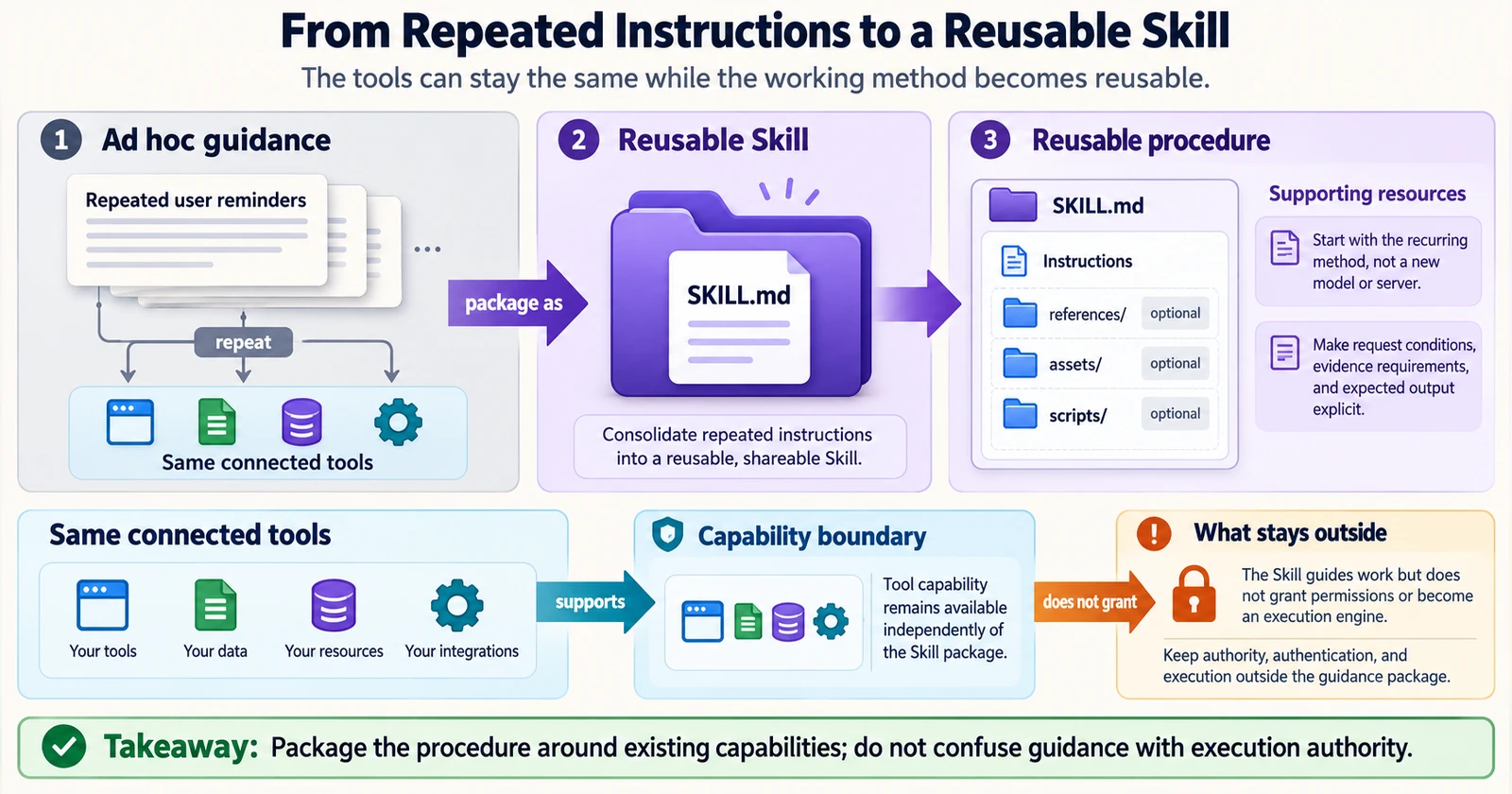
An Agent Skill is a folder containing instructions and, when needed, reference documents, scripts, or templates. The agent can load that task-specific guidance instead of requiring a user to repeat a long set of instructions for every similar request.
Anthropic introduced Agent Skills in 2025, and the approach has since expanded through the public Agent Skills specification and vendor implementations. OpenAI’s Skills documentation describes how skills guide recurring workflows that use MCP-backed tools.
A Skill is not another foundation model, a remote execution service, or a replacement for application logic. It is task guidance that the model can use. Contract review, code review, customer briefings, and document production are natural examples: the underlying data varies, while the review method should remain intelligible and reusable.
What goes in SKILL.md?
A minimal Skill needs a directory and a SKILL.md file. It starts with YAML frontmatter, then Markdown instructions. The name and description fields are required by the public specification. The description is especially important because it tells the agent when the Skill may be relevant.
Here is an illustrative, not production-validated, example for a B2B technical fit review:
---
name: b2b-solution-fit-review
description: Review B2B product fit using approved specifications and compatibility evidence; escalate unresolved claims for human review.
---
Its instructions might say:
- Identify the product and version from approved specifications.
- Check the compatibility matrix before narrowing the options.
- Mark missing or contradictory evidence as
UNRESOLVED. - Treat SME review hints as questions, not replacements for approved facts.
- Draft a recommendation for human review rather than updating CRM records.
Optional references/ files can hold detailed criteria, assets/ can supply templates, and scripts/ can contain deterministic checks. None of these directories is mandatory. Merely placing a script inside a Skill does not grant execution permission or ensure that every host runs it.
A useful Skill description states what user goal should trigger it. Its body then spells out decision points, expected evidence, and the desired output—not a vague promise that the agent will “do everything.”
How does an agent discover and load a Skill?
A central idea is progressive disclosure. Rather than loading every operational handbook into the model’s context, the host first presents concise metadata, including Skill names and descriptions. When a Skill appears relevant—or is explicitly requested—the agent reads its instructions and may open supporting files as needed.
That is more economical in context management than pasting dozens of complete manuals into every request. But the precise activation mechanism, filesystem access, and execution environment vary by platform. A SKILL.md file is not a universal workflow engine that guarantees identical execution across products.
Crucially, “call the CRM tool” is only an instruction. It does not make that tool available, authenticate the caller, or authorize data access.
Agent Skills vs MCP: the division of labor
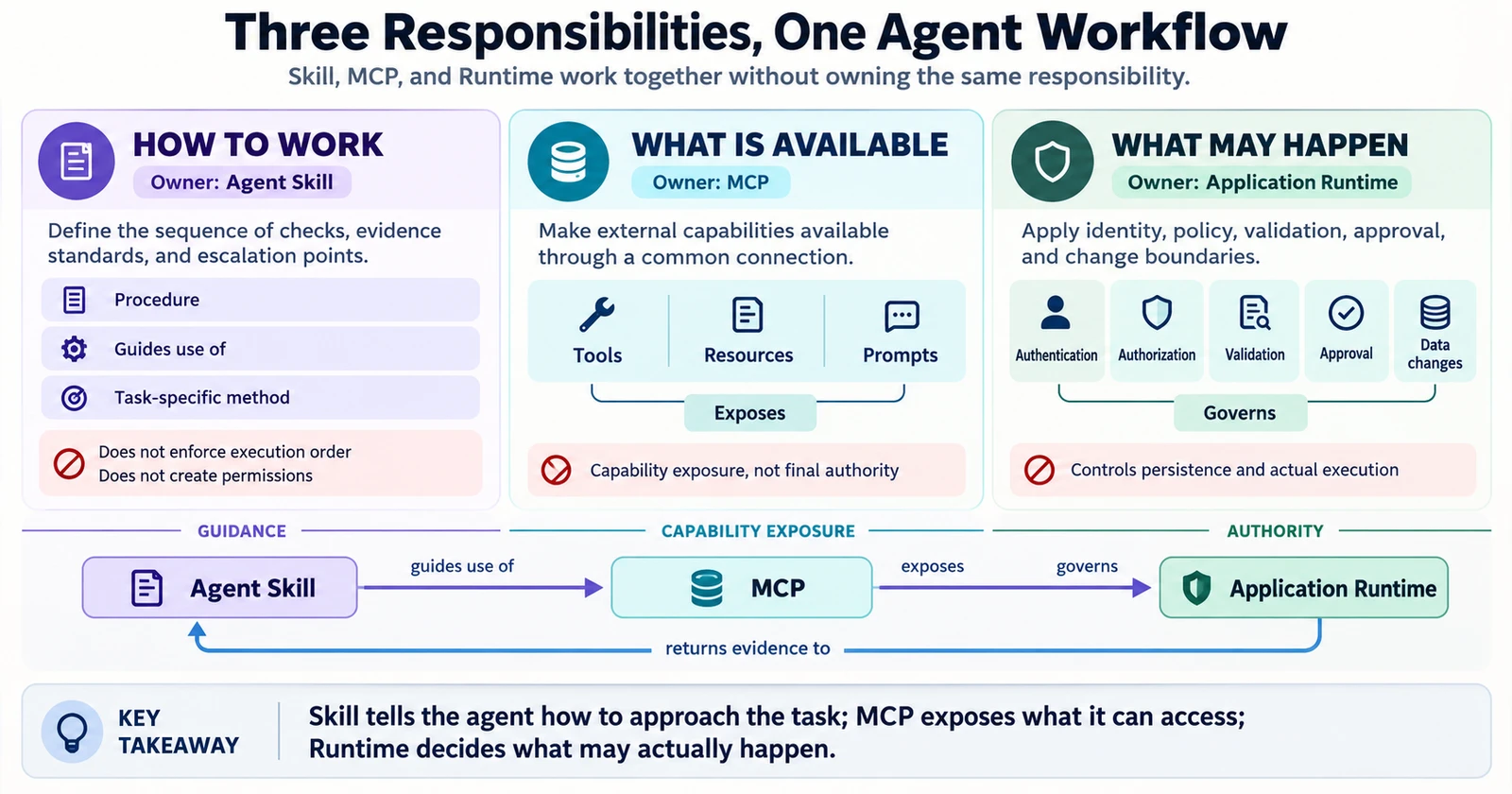
MCP, the Model Context Protocol, standardizes how model-based applications connect to external Tools, Resources, and Prompts. Tools expose callable operations; Resources supply context; Prompts provide reusable interaction templates. MCP Prompts and Skills can overlap in intent, but their packaging and execution models are not identical.
Consider a customer solution review:
- MCP exposes tools such as
get_product_spec,check_compatibility, andget_account. - A Skill explains when to inspect versions, which contradictory claims need escalation, and what a completed review should contain.
- The underlying API and runtime enforce service contracts, authorization, validation, and any durable business mutation.
Skills can be useful without MCP. MCP tools remain useful without a Skill. Together, they allow a connected capability to be used with more consistent task-specific guidance.
In an earlier discussion of MCP versus REST APIs, the question was whether enterprises needed to replace their existing interfaces. This question sits one level above connectivity: how should an agent use the interfaces it already has?
Can domain experts turn tacit knowledge into Skills?
Two engineers can read the same specification yet ask very different follow-up questions. Someone with years of industry experience may immediately examine deployment constraints, version dependencies, integration effort, and customer approval practices. None of that licenses the expert—or the agent—to invent missing specifications.
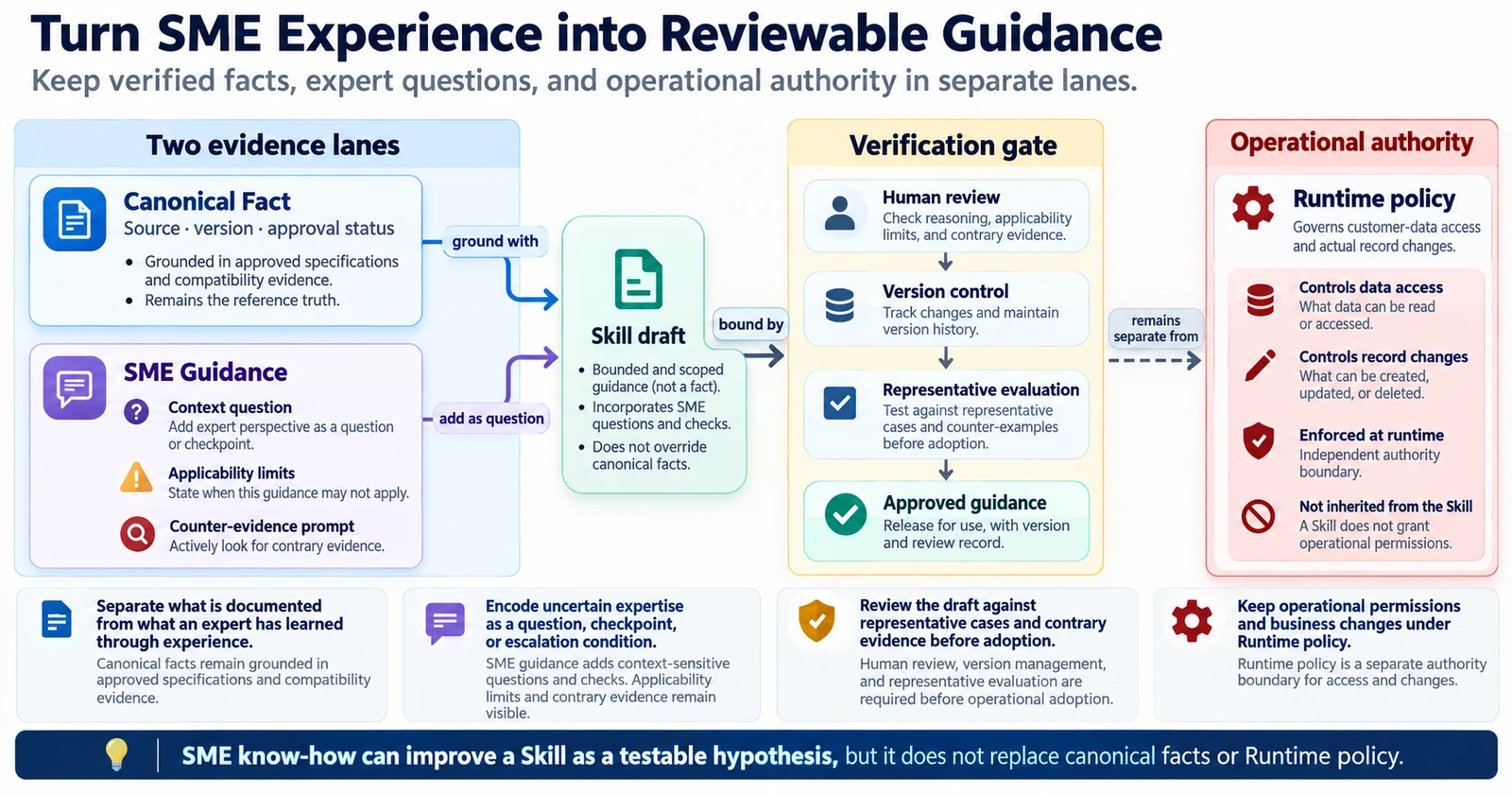
For enterprise design, it helps to separate three kinds of authority. Canonical data consists of verified product specifications and approved compatibility records with provenance and versions. SME guidance consists of experience-driven questions, exceptions, and investigative priorities. Runtime policy determines who may read an account or commit a change.
Suppose a domain expert says that isolated industrial networks frequently create hidden deployment constraints. A bounded Skill could ask the agent to check network restrictions for relevant projects and collect contrary evidence. It should not silently change the approved compatibility rules or insist that every customer needs the same solution.
An appropriate lifecycle is proposal, scope and counterexample review, approval, versioned packaging, and evaluation on representative tasks. Expert judgment can introduce selection bias. It should sharpen investigation, not be promoted into unquestioned organizational truth.
This is an engineering hypothesis, not a claim that Skills have already demonstrated a particular accuracy improvement. Evaluation should examine activation, tool selection, evidence completeness, counter-evidence, escalation decisions, and human corrections.
What Skills do not solve
A Skill is useful because its instructions are readable and revisable. The same characteristic makes it unsuitable as the sole enforcement mechanism for hard constraints. Prose cannot guarantee permission checks, correct tenant boundaries, exactly-once mutation, or a successful external transaction. Supporting scripts need trusted provenance and a controlled execution environment.
The other risk is institutionalizing the wrong habit. A Skill that consistently looks for evidence supporting one vendor’s solution may be easy to reuse and difficult to challenge. Good SME guidance should specify when to stop, what uncertainty remains, and which counterexamples must be checked.
After connection comes working method
It is tempting to describe Agent Skills as a new agent framework. A more practical interpretation is narrower: MCP lets an agent reach capabilities; Skills help it approach recurring work with less generic judgment.
For enterprise teams, that distinction matters. Two agents can use the same model, the same approved data, and the same tools, yet reach different levels of usefulness because one knows which questions to ask first. Capturing, reviewing, and updating that know-how can turn Skills into an operational asset—but it does not transfer ownership of facts, permissions, or business commits away from the application.
Official references: Agent Skills Specification, OpenAI Skills, Build Skills, MCP Overview.